French
  English
  Arabic
  German
  Indonesian
  Russian
  Italian
  Czech
Czech  Dutch
Dutch  Finnish
  Turkish
  Greek
Greek  Spanish
  Portuguese
Ⅰ.Introduction
Le béton à ultra-hautes performances (BUHP) représente la génération la plus avancée de matériaux à base de ciment, caractérisés par résistance exceptionnelle à la compression, durabilité supérieure et ouvrabilité exceptionnelle. L'obtention de ces propriétés nécessite une conception très optimisée des mélanges et des adjuvants chimiques avancés. Parmi eux, Superplastifiant à base de polycarboxylate (PCE) joue un rôle décisif.
Dans cet article, nous étudierons le fonctionnement du superplastifiant polycarboxylate dans les systèmes de BFUP, ses paramètres techniques, les recommandations de dosage, les considérations de compatibilité et les avantages en termes de performances dans les applications pratiques d'ingénierie.
Qu'est-ce qu'un superplastifiant à base de polycarboxylate ?
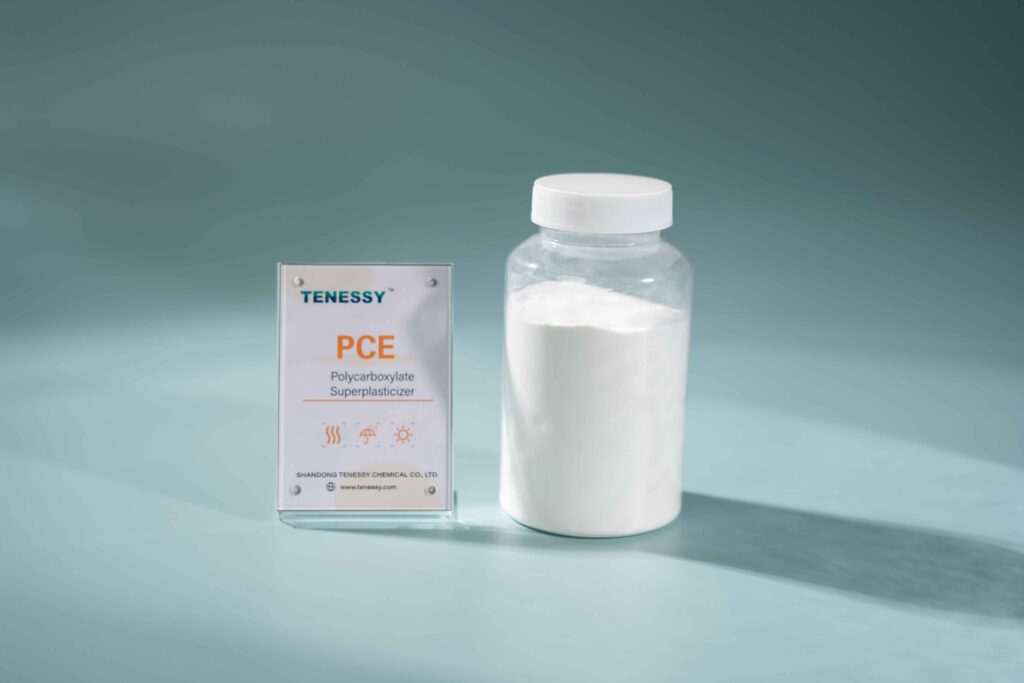
Le superplastifiant polycarboxylate (PCE) est un adjuvant réducteur d'eau à haut rendement basé sur une technologie avancée de polymères en forme de peigne. Contrairement aux superplastifiants traditionnels à base de naphtalène ou de mélamine, les molécules de PCE contiennent :
- Un squelette chargé négativement pour la répulsion électrostatique
- Chaînes latérales de polyéther offrant un encombrement stérique
Ce double mécanisme de dispersion permet une dispersion supérieure des particules de ciment, ce qui se traduit par.. :
- Réduction extrêmement élevée de la quantité d'eau
- Amélioration de la fluidité
- Rétention prolongée de l'affaissement
- Amélioration du développement de la force
Pour les applications UHPC, où le rapport eau/liant (w/b) varie généralement de 0,14 à 0,20La PCE est indispensable.
Ⅲ. Pourquoi le BFUP nécessite un superplastifiant de type polycarboxylate
Les formulations des BFUP comprennent généralement
- Ciment Portland ordinaire (OPC)
- Fumée de silice (10-25%)
- Poudre de quartz
- Sable de quartz fin
- Fibres d'acier (1-3% en volume)
- Très faible teneur en eau
Sans superplastifiant de haute performance, le mélange serait irréalisable.
Principaux défis dans le domaine de l'UHPC :
- Rapport eau-liant extrêmement faible
- Haute teneur en poudre (800-1000 kg/m³ de liant)
- Surface spécifique élevée de la fumée de silice
- Exigences en matière de dispersion des fibres
Le superplastifiant à base de polycarboxylate résout ces problèmes en offrant une grande fluidité sans augmenter la teneur en eau.
Ⅳ. Spécifications techniques du PCE pour le BFUP
Vous trouverez ci-dessous les paramètres techniques typiques d'un PCE haute performance conçu pour les applications UHPC :
Propriété | Spécifications |
Apparence | Liquide jaune clair à incolore |
Contenu solide | 40% ±1% |
Valeur du pH | 6.0 - 7.5 |
Densité (20°C) | 1,08 ±0,02 g/cm³ |
Teneur en chlorure | ≤ 0,1% |
Teneur en alcali (Na₂O eq.) | ≤ 5.0% |
Taux de réduction de la consommation d'eau | ≥ 30% (jusqu'à 40%) |
Rétention de l'affaissement | 60-120 minutes (réglable) |
Dosage recommandé | 0,15% - 0,35% du poids du liant |
Pour les PCE en poudre (séchés par pulvérisation) :
Propriété | Spécifications |
Apparence | Poudre blanche ou jaune clair |
Teneur en eau | ≤ 5% |
Contenu solide | ≥ 95% |
Taux de réduction de la consommation d'eau | ≥ 30% |
Avantages des performances des BFUP
1. Capacité élevée de réduction de la quantité d'eau
Les BFUP nécessitent une teneur en eau extrêmement faible. Un PCE de haute qualité peut atteindre :
- 30-40% réduction de l'eau
- Maintien de la fluidité à des rapports p/b inférieurs à 0,18
Cela permet d'obtenir des résistances à la compression supérieures :
- 120 MPa à 28 jours
- 150-180 MPa dans les systèmes optimisés
2. Coulabilité et capacité d'autocompactage supérieures
Diamètre typique d'une table d'écoulement UHPC :
- 240 - 300 mm (sans vibration)
Le superplastifiant à base de polycarboxylate assure :
- Dispersion uniforme de fumée de silice
- Viscosité réduite
- Amélioration de la distribution des fibres d'acier
3. Excellente rétention de l'affaissement
Pour les éléments préfabriqués en BFUP ou les transports de longue durée :
- Écart initial : 260 mm
- Après 60 minutes : ≥ 230 mm
Les performances de rétention peuvent être personnalisées en ajustant la structure du polymère (chaînes latérales plus longues ou groupes retardateurs).
4. Amélioration du développement de la force
En améliorant la dispersion du ciment et en réduisant la floculation :
- Résistance initiale (24h) : 50-80 MPa (avec durcissement à chaud)
- Résistance à la compression à 28 jours : 120-180 MPa
Une porosité plus faible se traduit par :
- Perméabilité réduite
- Durabilité accrue
- Amélioration de la résistance au gel et au dégel
Ⅵ. Compatibilité avec les matériaux UHPC
Un PCE performant doit démontrer sa compatibilité avec :
Types de ciment
- ASTM Type I/II OPC
- CEM I 52.5R
- Ciment à faible teneur en alcali
Matériaux cimentaires supplémentaires (MCS)
- Fumée de silice (10-25%)
- Laitier granulé de haut fourneau moulu (GGBS)
- Cendres volantes (classe F)
Fibres
- Fibres d'acier
- Fibres de polypropylène
- Fibres de basalte
Une bonne compatibilité assure un débit stable et évite l'entraînement excessif d'air.
Ⅶ. Dosage recommandé dans l'UHPC
Dosage typique :
- 18% - 0,30% en poids de liant total
Exemple de mélange UHPC :
Composant | Quantité (kg/m³) |
Ciment | 750 |
Fumée de silice | 180 |
Poudre de quartz | 150 |
Sable | 1000 |
L'eau | 160 |
Fibre d'acier | 150 |
PCE | 2.0 - 3.0 |
Le dosage final doit être optimisé par des essais en laboratoire.
Ⅷ. Domaines d'application du BFUP avec PCE
Le superplastifiant à base de polycarboxylate permet d'utiliser le BFUP dans.. :
- Poutres de pont
- Panneaux de façade préfabriqués
- Structures marines
- Tours d'éoliennes
- Composants pour trains à grande vitesse
- Éléments architecturaux minces
Dans les industries de la préfabrication, le développement rapide de la résistance permet un démoulage dans les 24 heures dans des conditions de durcissement à la vapeur.
Ⅸ. Conclusion
Le superplastifiant polycarboxylate est un composant essentiel des bétons à ultra-hautes performances (BUHP). Sa structure moléculaire avancée fournit :
- Forte réduction de l'eau (≥30%)
- Excellente fluidité
- Rétention supérieure de l'affaissement
- Amélioration de la résistance jusqu'à 180 MPa
- Compatibilité avec les fumées et les fibres de silice
Sans la technologie PCE, le BFUP moderne ne serait pas techniquement ou économiquement réalisable.
Pour les producteurs de BFUP à la recherche de performances optimales, la sélection d'un superplastifiant polycarboxylate de haute qualité avec des paramètres techniques vérifiés et des tests de compatibilité est essentielle pour obtenir des résultats cohérents et fiables.