

 Czech
Czech  English
  Arabic
  German
  French
  Indonesian
  Russian
  Italian
  Dutch
Dutch  Finnish
  Turkish
  Greek
Greek  Spanish
  Portuguese
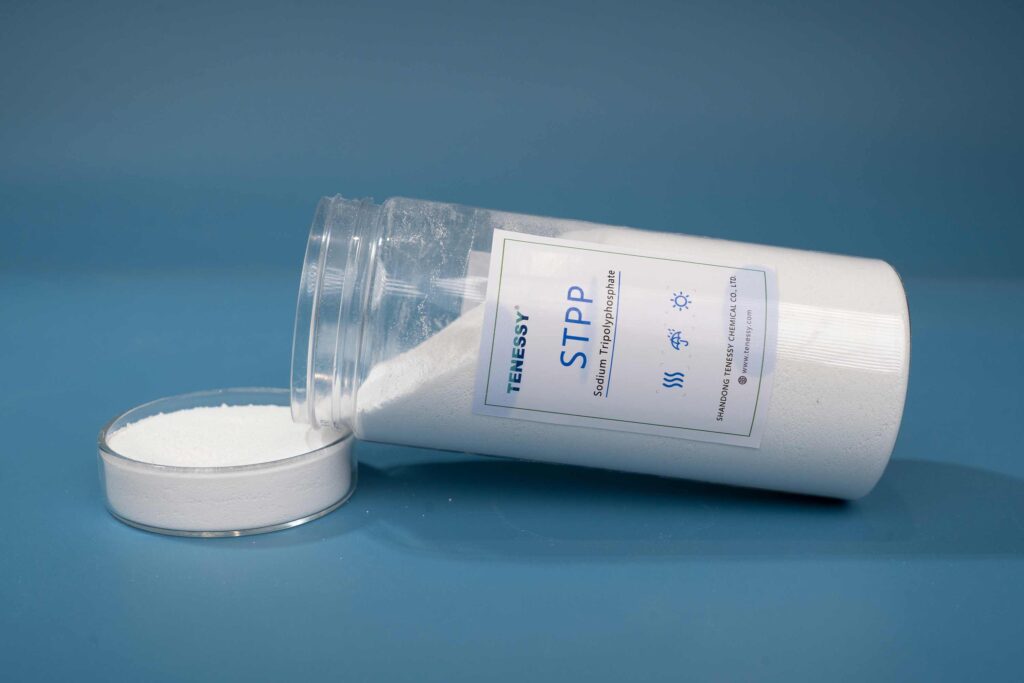
Na adrese detergent formulation systems, the choice of builder directly affects the final performance of the product. Sodium Tripolyphosphate (STPP) is a well-established detergent builder with decades of application history in the detergent industry.
The role of STPP in detergent formulations is primarily reflected in three aspects: chelating calcium and magnesium ions in water, dispersing soil to prevent redeposition, and maintaining an alkaline environment during the washing process. These functions give STPP significant application value in specific washing scenarios.
This article is intended for detergent formulation engineers and procurement decision-makers. It provides a practical overview of STPP’s functional role in future detergent applications, suitable use cases, and key selection considerations.
I. Core Functions and Mechanism of STPP
1. Chelating Calcium and Magnesium Ions to Reduce Water Hardness
Water hardness is an important factor affecting detergency. Calcium and magnesium ions in hard water react with surfactants to form insoluble precipitates, reducing the availability of active ingredients.
STPP forms soluble chelates with calcium and magnesium ions, encapsulating these metal ions within its molecular structure so they no longer interfere with surfactant performance. This mechanism determines STPP’s effectiveness under hard water conditions.
Practical value: In regions with high water hardness or in industrial cleaning applications, STPP helps maintain detergency and prevents reduced cleaning efficiency caused by water quality issues.
2. Dispersing Soil to Prevent Redeposition
During the washing process, once soil is detached from fabrics or hard surfaces, it must be effectively dispersed and suspended; otherwise, it will reattach to the items being cleaned, resulting in graying, yellowing, or surface residues.
STPP has good dispersing and emulsifying properties. It keeps removed soil stably suspended in the wash solution, preventing it from settling back onto the cleaned surface. This function is particularly important for maintaining the whiteness of white fabrics and the shine of dishware.
Practical value: In commercial laundry, hotel linen washing, and other applications where whiteness retention is critical, STPP’s anti-redeposition function helps maintain a clean appearance of fabrics.
3. Maintaining an Alkaline Environment to Enhance Detergency
Greasy and oily soils are more easily emulsified and removed under alkaline conditions. STPP is alkaline in aqueous solution and has pH buffering capacity, helping to maintain a stable alkaline environment throughout the washing process.
Additionally, STPP chelates heavy metal ions such as iron and manganese in water, reducing their catalytic decomposition of bleaching agents and protecting bleach ingredients so they perform effectively when needed.
Practical value: In detergent products containing bleach ingredients (such as laundry powders and automatic dishwashing detergents), STPP contributes to improved product stability and use performance.
II. Detergent Product Types Where STPP Is Applicable
STPP is not suitable for all washing scenarios, but it has clear application value in the following product types.
Automatic Dishwashing Detergents
Automatic dishwashers have specific requirements for detergents: low foam, strong removal of starch and protein soils, protection of glassware from corrosion, and prevention of scale buildup on heating elements and spray arms.
STPP meets multiple requirements:
Strongly chelates calcium and magnesium ions to prevent scale formation
Protects glass surfaces from corrosion
Effectively disperses food residues to prevent redeposition
Globally, automatic dishwashing detergents are one of the main application areas for STPP.
Industrial and Commercial Laundry Powders
Commercial laundry applications such as hotel linen, hospital textiles, and workwear cleaning require high cleaning efficiency and whiteness retention. These applications typically involve large water volumes, varying water quality conditions, and heavy soil loads.
STPP contributes in the following ways:
Addresses variations in water hardness across different regions
Prevents graying and yellowing of fabrics after repeated washing
Ensures cleaning effectiveness under heavy soil conditions
Export-Oriented Detergent Products
Different countries and regions have different requirements and preferences for detergent formulations. In markets such as Southeast Asia, the Middle East, Africa, and Latin America, STPP remains widely accepted and used in various detergent products.
For detergent manufacturers targeting these markets, STPP is one of the available builder options in formulation design.
Compact/Concentrated Laundry Powders
Concentrated laundry powders are required to maintain or improve detergency while reducing dosage. STPP has high builder efficiency, achieving the desired building effect at lower usage levels.
Additionally, STPP provides good particle flowability and anti-caking properties, helping to maintain the physical stability of concentrated powders.
III. Considerations for STPP Selection
When evaluating STPP as a formulation ingredient, customers are advised to assess the following factors.
1. Water Quality in the Target Market
Local water hardness is a key factor in determining whether STPP is needed. In regions with high water hardness, the chelating effect of STPP is more pronounced.
2. Product Performance Positioning
For products positioned for strong detergency, high whiteness retention, and heavy soil removal, STPP can provide meaningful performance support.
3. Regulatory Requirements in the Target Market
Different countries and regions have different regulations regarding the use of STPP in detergents. It is advisable to confirm specific requirements for the target market during formulation design.
4. Compatibility with the Formulation System
STPP has good compatibility with enzymes, surfactants, bleaching agents, and other ingredients, making it suitable for various formulation systems.
IV. TENESSY's Services
TENESSY is committed to providing professional STPP products and related technical support to detergent manufacturers.
Product Supply
- Industrial-grade STPP suitable for various detergent formulations
- Stable supply chain ensuring batch-to-batch consistency
- Flexible packaging options to meet different purchasing requirements
Technická podpora
- Guidance on STPP usage levels in detergent formulations
- Assistance with formulation performance evaluation and optimization
- Selection recommendations based on customer product positioning
Cooperation Models
- Support for sample testing and small-scale trial production
- Reasonable pricing based on purchase volume
- Professional logistics to ensure timely delivery
Závěr
STPP is a long-established detergent builder with decades of proven performance in the detergent industry. In application scenarios such as automatic dishwashing detergents, industrial laundry powders, export-oriented products, and concentrated laundry powders, STPP continues to play a meaningful role.
TENESSY recommends that customers evaluate the suitability of STPP in their formulations based on their product positioning, target markets, and cost structure. For further information on STPP technical specifications or to conduct formulation testing, please kontakt the TENESSY technical team.








-scaled.jpg)

