Finnish
  English
  Arabic
  German
  French
  Indonesian
  Russian
  Italian
  Czech
Czech  Dutch
Dutch  Turkish
  Greek
Greek  Spanish
  Portuguese
In the rapidly evolving world of rakennusmateriaalit, concrete admixture technology plays a decisive role in determining the performance, durability, and efficiency of concrete structures. Among all categories of superplasticizers, Polycarboxylate Ether (PCE) Superplasticizers have emerged as the most advanced and widely adopted generation. Their exceptional water-reducing capability, superior slump retention, and tailor-made molecular design significantly outperform conventional technologies such as naphthalene-based, melamine-basedja sulfonated high-range water reducers.
As infrastructure demands become more complex and quality standards more stringent, understanding the differences between PCE superplasticizers and traditional high-range water reducers is essential for ready-mix producers, precast manufacturers, engineers, contractors, and project owners seeking reliable, high-performance, and sustainable solutions.
This article presents a comprehensive and in-depth comparison of these two categories, highlighting structural principles, performance benefits, application features, and economic advantages.
Ⅰ.Molecular Structure: Modern Engineering vs. Conventional Chemistry
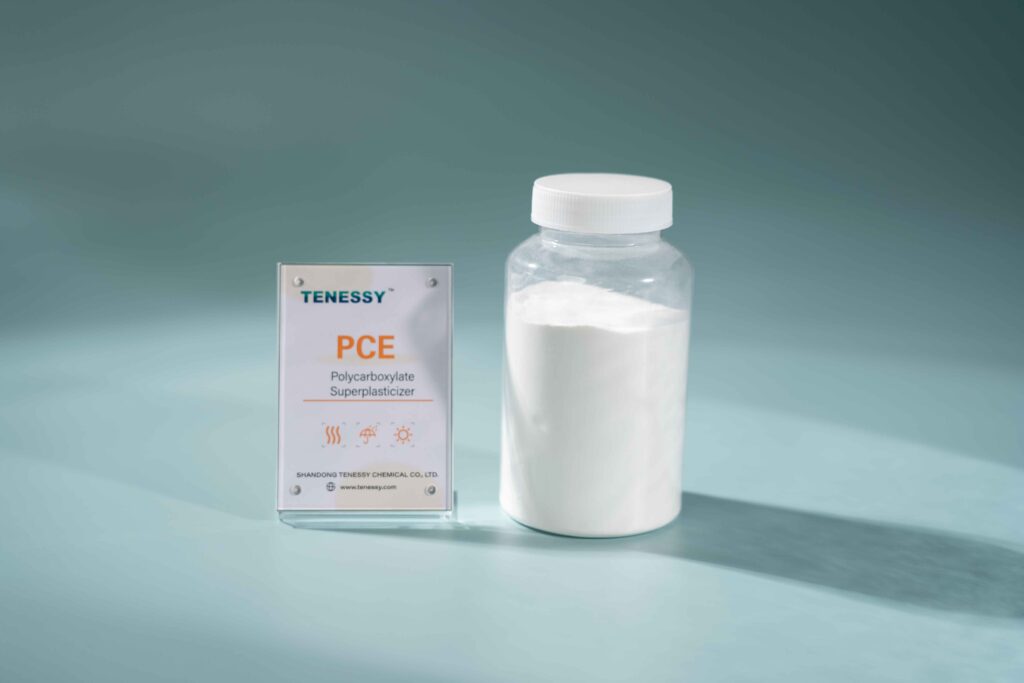
Polycarboxylate Superplasticizers (PCEs)
PCEs feature a highly engineered comb-shaped molecular structure composed of a long backbone with polyether side chains. This unique configuration provides:
- Steric hindrance dispersion, allowing cement particles to remain optimally separated
- Controlled adsorption behavior, enabling adjustable workability and slump retention
- Precise molecular customization, making it possible to adapt PCEs for different cements, aggregates, and project requirements
Because their structure can be tailored at the molecular level, manufacturers can produce PCE products with specific characteristics such as:
- Slow-release slump retention
- Rapid early-strength development
- Low-viscosity flow performance
- Compatibility with supplementary cementitious materials (SCMs)
Traditional High-Range Water Reducers
Conventional admixtures (e.g., SNF, SMF, lignosulfonates) rely mainly on electrostatic repulsion to disperse cement particles. Their linear structures have limited modification potential, resulting in:
- Faster slump loss
- Lower water-reducing capacity
- Reduced adaptability to modern concrete mix designs
Conclusion: The molecular advantage of PCEs is the foundation for their superior performance.
Ⅱ.Water Reduction Efficiency: Achieving Higher Strength With Less Water
The primary function of a superplasticizer is to reduce water demand while maintaining workability.
PCE:n pehmittimet
- Typical water reduction: 25–35%
- Premium formulations: up to 40–45%
- Improved cement hydration and microstructure formation
- Enhanced compressive strength at all ages
Traditional High-Range Water Reducers
- Typical water reduction: 15–20%
- Limited performance with low water-cement ratios
- Less effective in producing dense, high-strength concrete
Impact: Higher water reduction translates directly into improved strength, lower permeability, and better long-term durability—essential for modern infrastructure, industrial floors, and high-rise structures.
Ⅲ. Slump Retention: Stability for Modern Construction Needs
Concrete workability must remain stable during transportation, placement, and finishing.
Advantages of PCE Admixtures
PCEs excel in long-lasting slump retention, especially in:
- Ready-mix concrete transported over long distances
- Mass pours requiring consistent rheology
- Self-compacting concrete (SCC) and pumping concrete
- Hot climate conditions
Their controlled molecular adsorption allows the release of dispersing chains over time, maintaining fluidity without segregation.
Limitations of Traditional Reducers
- Rapid slump loss
- Higher risk of re-dosing on-site
- Inconsistent behavior in high cement or SCM content mixes
Benefit: PCEs reduce labor costs, minimize variability, and ensure stable, predictable performance.
Ⅳ. Compatibility and Flexibility in Mix Design
As concrete technology advances, mix designs have become more sophisticated.
PCE:n pehmittimet
PCEs are highly compatible with:
- Portland cement of various grades
- Fly ash, slag, silica fume, and limestone powder
- High-performance concretes (HPC) and ultra-high-performance concretes (UHPC)
- Precast and prestressed concrete requiring rapid strength gain
- Self-compacting and pumpable concretes
Traditional Reducers
- Limited compatibility with blended cements
- Poor adaptability to low water–cement ratios
- Limited use in high-performance or engineered concretes
Ⅴ. Rheological Performance: Flowability Without Segregation
Concrete rheology refers to its flow behavior.
PCE Advantages
Produces a smooth, cohesive, and stable mix
- Reduces viscosity, enhancing pumpability
- Ideal for SCC and thin-section architectural elements
- Less prone to bleeding or segregation
Traditional Reducer Disadvantages
- Inconsistent flow profile
- More prone to bleeding
- Difficult to stabilize at high fluidity levels
Conclusion: For visually critical concrete, precast elements, and complex geometries, PCEs deliver superior aesthetics and finish quality.
Ⅵ. Environmental and Sustainability Benefits
Sustainability has become a major priority in modern construction.
PCEs Support Green Building Standards
- Lower cement demand due to high water-reducing efficiency
- Reduced energy consumption in precast curing
- Optimized mix designs for lower CO₂ emissions
- Increased durability, reducing lifecycle maintenance costs
Traditional Reducers
- Higher cement content required
- Lower efficiency in low-carbon mix designs
- Less suitable for green construction certifications
Outcome: PCEs contribute to eco-friendly, cost-effective, and durable construction solutions.
Ⅶ. Economic Benefits: Higher Performance at Lower Lifetime Cost
While PCEs may appear more expensive per kilogram, their cost-performance ratio is significantly superior.
Cost Advantages of PCEs
- Lower dosage required
- Reduced cement consumption
- Fewer jobsite adjustments
- Improved production efficiency for precast plants
- Better long-term durability reduces repair costs
Costs of Traditional Reducers
- Higher dosage
- Increased cement requirement
- Additional labor and re-dosing
- Greater variability leading to waste
Economic Conclusion: PCEs offer a strong return on investment across the entire project lifecycle.
Ⅷ. Application Comparison Table
Hakemus | PCE:n pehmittimet | Traditional Reducers |
High-Strength Concrete | Erinomainen | Kohtalainen |
Self-Compacting Concrete | Erinomainen | Huono |
Betonielementit | Erinomainen | Hyvä |
Ready-Mix Long Distance | Erinomainen | Fair |
Pumping Concrete | Erinomainen | Fair |
Ordinary Structural Concrete | Erinomainen | Hyvä |
Ⅸ. The Future Direction of Concrete Admixtures
With construction techniques advancing rapidly—3D printing concrete, ultra-high-strength materials, and high-performance precast systems—admixtures must deliver precision, reliability, and environmental stewardship.
PCE superplasticizers align perfectly with these trends:
- Highly tunable molecular design
- Compatibility with emerging binders such as calcined clay
- Low-carbon construction systems
- Requirements for extremely high flowability and stability
Traditional reducers, while still useful in limited applications, are no longer sufficient for the demanding performance specifications of modern civil engineering.
Ⅹ. Conclusion: Why PCE Superplasticizers Have Become the Industry Standard
Polycarboxylate superplasticizers represent a fundamental advancement in admixture technology. Their ability to deliver:
- Superior dispersion efficiency
- Exceptional water reduction
- Outstanding slump retention
- High compatibility with modern materials
- Enhanced sustainability and economic advantages
makes them the preferred choice for forward-thinking producers and contractors worldwide.
As construction evolves toward higher performance, stricter environmental standards, and more complex engineering designs, switching to polycarboxylate-based high-range water reducers is not just an improvement—it is essential for competitiveness and long-term success.
If you need custom-engineered PCE formulations, technical consultation, or high-quality admixture supply, our team is ready to support your project with innovative solutions and professional expertise.