English
  Arabic
  German
  French
  Indonesian
  Russian
  Italian
  Czech
Czech  Dutch
Dutch  Finnish
  Turkish
  Greek
Greek  Spanish
  Portuguese
Ⅰ. Self-Leveling Gypsum
Self-leveling gypsum, also known as gypsum self-leveling mortar or simply gypsum self-leveling, is a dry powder material specifically used for indoor floor leveling. It is composed of high-strength gypsum, aggregates, and various building chemical additives that are configured and mixed uniformly in a factory.
Ⅱ.The main gelling material of gypsum-based self-leveling mortar is gypsum, and it has self-leveling properties, with the following advantages:
1. Outstanding Dimensional Stability
The slight expansion characteristic of gypsum results in a very low shrinkage rate (-0.05% to +0.05%) after the material hardens. It is unlikely to crack within a construction thickness range of 1-10 cm, fundamentally solving the problems of hollow drums and cracks caused by shrinkage in cement-based materials. This property makes it an ideal choice for underfloor heating backfill layers, effectively avoiding the cracking and bulging caused by thermal expansion and contraction in traditional cement mortar.
2.Significant Construction
Efficiency High fluidity: After mixing with water, it forms a highly fluid slurry that can automatically level itself, with a 2-meter straightedge deviation of less than 2 mm. Fast hardening: Initial setting time ≥ 1 hour, final setting time ≤ 6 hours. It can be walked on 4-6 hours after construction, and the strength can reach 90% of the design value within 24 hours. Mechanized construction: Using pump delivery for construction, a single machine can cover an area of more than 2,000 square meters per day, reducing the construction period by more than 70% compared to traditional cement mortar.
3. Excellent Physical Properties
Performance Indicator | G25 Grade Filling Mortar | Insulating Mortar | Advantage Explanation |
28-day dry compressive strength | ≥25MPa | ≥2.5MPa | Meets the load requirements for home decoration and general industrial decoration |
28-day dry flexural strength | ≥4.0MPa | ≥1.0MPa | Has good crack resistance |
Dry density | Approximately 1600kg/m³ | 600-800kg/m³ | 30% lighter than cement-based materials, reducing building load |
Thermal conductivity | 0.71-0.76W/(m·K) | ≤0.075W/(m·K) | Has both thermal insulation and heat insulation properties |
Softening coefficient | ≥0.80 | ≥0.80 | Must meet this requirement when used in wet areas |
Fire performance | Class A | Class A | Natural fire-resistant material |
4.Environmental and Functional Features
Environmental safety: Made from natural gypsum or industrial by-product gypsum (desulfurization gypsum, phosphogypsum), it contains no harmful substances such as formaldehyde or benzene, and there is no odor during construction.
Humidity regulation function: The micro-porous structure of gypsum can absorb excess moisture from the air and release it when dry, regulating indoor humidity.
Sound insulation performance: It meets the requirements of the “Code for Sound Insulation Design of Civil Buildings” GB50118, enhancing living comfort.
Ⅲ.To achieve good construction results, gypsum-based self-leveling mortar usually needs to add the following types of additives:
1.Gypsum Retarder
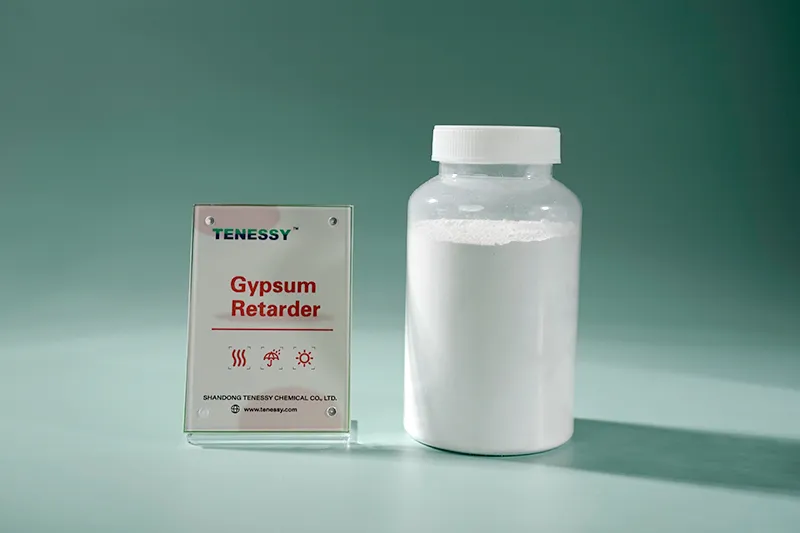
Extends the setting time of gypsum, determining the workable time of gypsum-based materials during construction or shaping; it has a significant impact on the strength of hardened gypsum. Different retarders have different degrees and ways of influence; it delays the acceleration stage of gypsum hydration, reduces the peak heat release during hydration, affects the crystal morphology and microstructure of gypsum, and thus affects the strength of gypsum.
TENESSY Chemical, based on market demand, has launched two gypsum retarder products:
It performs well under neutral conditions, but its performance is affected by lime in alkaline conditions (such as plaster gypsum with added lime), resulting in a loss of retardation time. Increasing the dosage can extend the setting time but will also increase costs.
(2)Alkali-resistant Gypsum Retarder
The alkali-resistant type has strong tolerance for lime added to gypsum and is suitable for adding any proportion of lime, with stable retardation time.
Advantages of TENESSY Gypsum Retarder Products:
- Stable synthesis process, with strict incoming inspection of raw materials, ensuring controllable quality of raw materials
- Good batch stability, with stable retardation effect
- Odorless, mold-resistant, and mildew-resistant (non-mold-resistant retarder)
- Good dispersion in water, easily soluble in water
- Stable molecular weight, with long-term storage stability
- The alkali-resistant type has strong tolerance for lime added to gypsum, suitable for adding any proportion of lime, with stable retardation time
2.Water Reducer

By adsorbing on the surface of gypsum particles, it releases the water that is wrapped, allowing the slurry to achieve higher fluidity (initial fluidity ≥260mm) with the same amount of water, or reduce the water usage while maintaining the same fluidity, thereby increasing the density and strength of the hardened body.
Technical requirements: Preferred polycarboxylate water reducer: High dispersion efficiency, small fluidity loss within 30 minutes, and no negative impact on the strength development of gypsum Dosage: Usually 0.2-1.0% of the total amount of powder, which needs to be precisely adjusted according to the type (desulfurization gypsum/phosphogypsum) and fineness of gypsum Synergistic effect: When used in combination with retarder, the order of addition needs to be optimized to avoid interference in dispersion effect
Advantages of TENESSY PCE (Polycarboxylate Superplasticizer Powder)
- Fast dispersion, extremely short mixing time
- High water reduction rate, low water demand
- Long-lasting fluidity retention
- Good workability, no bleeding, good anti-segregation performance, good pumpability
- Wide adaptability, compatible with Portland cement, ordinary Portland cement, slag Portland cement, fly ash Portland cement, and various mineral admixtures
- Extremely low alkali and chloride ion content, will not corrode steel bars
- Stable performance, good long-term storage stability
- Non-toxic, harmless, and odorless
3.Defoamer

Quickly breaks down bubbles introduced during mixing and construction, preventing the formation of pinholes and pitting on the surface after hardening, while also increasing the wet density and mechanical properties of the mortar.
Application tips:
Timing of addition: Added together with the powder to ensure full dispersion
Dosage: 0.05-0.1% of the total amount of powder, excessive amount may cause surface floating oil Construction coordination: Must be used in combination with a defoaming roller, repeatedly rolling within 15-20 minutes before initial setting, with the combined effect of physical and chemical defoaming
Advantages of TENESSY Powder Defoamer
- Good defoaming performance, low dosage
- Fast defoaming speed, long foam suppression time
- Does not affect the basic properties of the system when added to mortar
- Good diffusion and penetration
- Stable chemical nature, good heat resistance and oxidation resistance
4.Hydroxypropyl Methylcellulose (HPMC)

Ensures the flow performance of the mortar and endows the mortar with excellent water retention properties; reduces the water sensitivity of the mortar, reduces sedimentation and bleeding, and increases the surface strength and wear resistance of the hardened mortar.
It is recommended to use TENESSY hydroxypropyl methyl cellulose with a viscosity of 400mPa.s.
This viscosity of cellulose can ensure the good fluidity of self-leveling mortar (the higher the viscosity of cellulose, the worse the fluidity), improve the anti-sedimentation ability of self-leveling mortar, help form a smooth surface, reduce its shrinkage rate, increase its load-bearing capacity, and improve its adhesion to the base and internal cohesion.
Ⅳ. Basic Formula for Gypsum Self-Leveling
Name | Sand-free | Sand-containing |
Hemihydrate gypsum | 800-1000 | 400-600 |
Ordinary Portland cement | 0-100 | 0-100 |
Graded river sand | 0 | 0-200 |
Heavy calcium powder | 0-200 | 0-200 |
Fly ash | 0-100 | 0-100 |
Hydroxypropyl methylcellulose with 400 viscosity | 0-1 | 0-1 |
Retarder | As required | As required |
Lime | 0-10 | 0-10 |
Water reducer | 0-2 | 0-2 |
Defoamer | 0-1 | 0-1 |


-scaled.jpg)