English
  Arabic
  German
  French
  Indonesian
  Russian
  Italian
  Czech
Czech  Dutch
Dutch  Finnish
  Turkish
  Greek
Greek  Spanish
  Portuguese
Introduction
In the formulation design of daily chemical cleaning products, there is an indispensable “invisible guardian.” Although it often appears near the end of the ingredient list—sometimes even below fragrances and preservatives—its contribution to the final product experience is critically important. This ingredient is Disodium EDTA, commonly referred to as EDTA-2Na.
For TENESSY’s R&D team and industry partners, understanding EDTA-2Na goes beyond familiarizing ourselves with its physicochemical specifications. It requires deep insight into its coordination chemistry behavior within complex fluid environments and its regulatory mechanisms across different phases. This article will analyze the core value of EDTA-2Na in daily chemical cleaning from a mechanistic perspective.
I. Basic Physicochemical Properties of EDTA-2Na and the Essence of Chelation
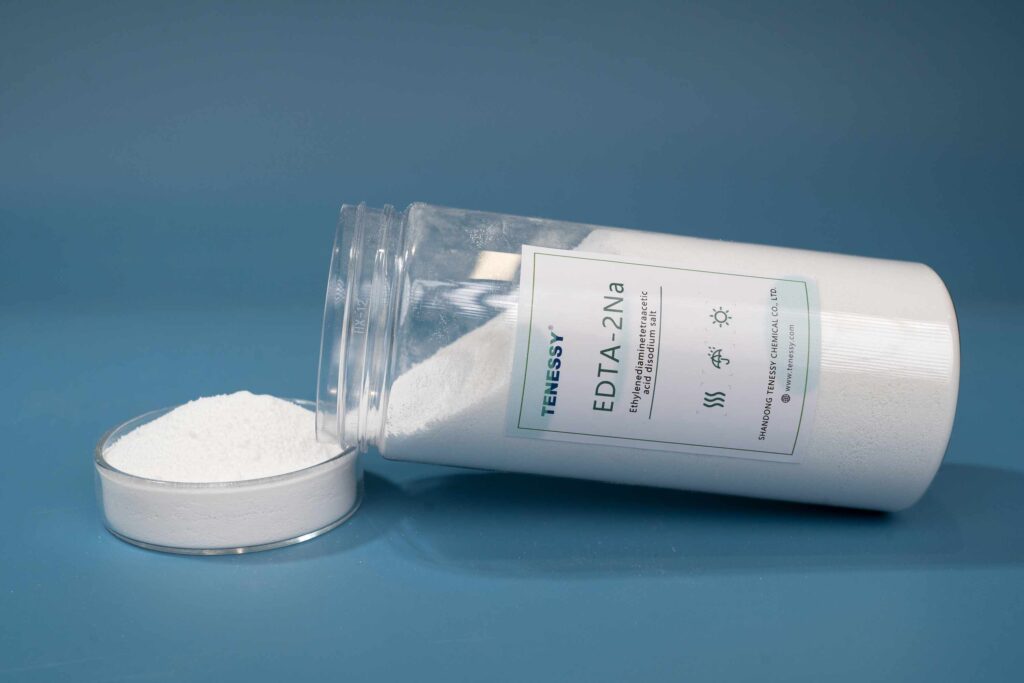
EDTA-2Na, with the chemical formula C₁₀H₁₄N₂Na₂O₈·2H₂O, is a white crystalline powder soluble in water. Its core functional groups consist of two amino groups and four carboxyl groups, which together form a coordination space with high electron density.
From the perspective of coordination chemistry, the mechanism of EDTA-2Na is a typical multidentate ligand chelation process. It acts like a precise “molecular handcuff,” providing lone-pair electrons to form stable, ring-structured chelates with free metal ions in solution (primarily divalent and trivalent metal ions). The formation constants of these chelates are extremely high, meaning that once bound, the metal ions are “passivated” and no longer participate in subsequent side reactions.
II. Core Mechanisms: Four Targeted Regulatory Roles in Daily Chemical Cleaning
In shampoos, body washes, laundry detergents, or facial cleansers, EDTA-2Na serves several key functions beyond simple complexation:
1. Hard Water Control: Eliminating Soap Scum and Enhancing Foaming Performance
The greatest challenge for daily chemical cleaning products during use is water hardness. The Ca²⁺ and Mg²⁺ ions in water are the natural enemies of traditional surfactants (such as fatty acid salts and soap bases).
Mechanism: When EDTA-2Na is added to water, its affinity for Ca²⁺ and Mg²⁺ is much higher than that of fatty acid ions. It rapidly captures these hardness ions, forming soluble chelated complexes.
Macroscopic Effects: Effectively prevents the formation of insoluble “soap scum” (metal soaps). This not only avoids white precipitate deposits on fabric fibers or hair cuticles—keeping colors vibrant and hair smooth—but also eliminates the interference of hard water on surfactants, significantly improving foaming speed and foam density, ensuring full cleaning power.
2. Antioxidant Synergy: Protecting Fragrances and Active Ingredients
The degradation of cosmetic raw materials largely stems from autoxidation reactions. Trace amounts of Fe³⁺ and Cu²⁺ act as powerful oxidation catalysts.
In-depth Mechanism: These transition metal ions catalyze the decomposition of peroxides, generating free radicals that lead to oil rancidity, fragrance discoloration, and the deactivation of active ingredients such as vitamins C and E.
Role of EDTA-2Na: By filling the electron orbitals of Fe³⁺/Cu²⁺(coordination saturation), it completely deprives them of their catalytic activity. This “antioxidant synergy” effectively extends the product’s shelf life and protects natural extracts and functional ingredients from degradation.
3. Preservative Enhancement: Breaking Down Microbial Protection
In the preservative systems of daily chemical products, EDTA-2Na acts as a “pathbreaker.”
Unique Mechanism: The cell walls of bacteria and fungi have an outer protective layer composed of lipopolysaccharides and proteins, in which magnesium ions play a key role in maintaining structural stability and forming a material barrier.
Process: EDTA-2Na chelates the Mg²⁺ in the outer cell membrane, disrupting its structure and increasing cell wall permeability.
Practical Application: This allows traditional preservatives (such as phenoxyethanol and parabens) to enter cells more easily and exert their toxic effects. Thus, EDTA-2Na lowers the required dosage of preservatives, enhances the overall efficacy of the preservative system, and maintains efficient antibacterial effects even in neutral or weakly acidic environments.
4. Stabilizer and Clarifying Agent: Maintaining Physical Appearance
In transparent soap bases or high-surfactant systems, EDTA-2Na also addresses “cloudiness” issues.
Phenomenon Explanation: Trace metal impurities from raw materials or salts in water can, at certain concentrations, alter the micellar structure of surfactants, leading to precipitation or cloudiness.
Response Mechanism: By binding these interfering ions, EDTA-2Na stabilizes the micellar state, thereby restoring and maintaining a clear, transparent product appearance—a critical quality control parameter for “clear laundry detergents” or “body washes.”
III. Precise Formulation: Concentration Gradients and Application Scenarios
When using EDTA-2Na, TENESSY recommends precise dosage design based on product positioning. According to industry benchmark data:
Skincare/Color Cosmetics (serums, lotions, foundations): Typically controlled at 0.05% – 0.2%. The main purpose is to prevent oxidative discoloration and protect sensitive active ingredients, with attention to avoiding temporary minor disturbances to the skin barrier caused by over-chelation.
Personal Care (shampoos, body washes): Recommended dosage is 0.1% – 0.5%. The core function is to chelate hardness ions from tap water and improve post-wash feel.
Household Cleaning (laundry detergents, dish soaps): Dosage may increase to 0.2% – 0.8% , or even higher (up to several percentage points in industrial paint removers or heavy-duty degreasers), to cope with high water hardness and extreme interference from dirt ions.
Conclusion
In today’s increasingly competitive daily chemical cleaning industry, formulation differentiation often lies in the “invisible details.” What consumers perceive—whether it’s rich foam, brighter laundry, or smooth post-bath skin—has, in the eyes of formulators, its underlying logic inextricably linked to EDTA-2Na’s precise “masking” of one or two metal ions.
The value of EDTA-2Na is never about standing in the spotlight; it is about serving as the most reliable backbone, ensuring that every active ingredient performs its intended function in an optimal environment. For TENESSY, we do not simply supply raw materials that meet regulatory standards. We are committed to helping partners look beyond the formulation surface and understand the true role of each molecule within the system.