English
  Arabic
  German
  French
  Indonesian
  Russian
  Italian
  Czech
Czech  Dutch
Dutch  Finnish
  Turkish
  Greek
Greek  Spanish
  Portuguese
HPMC for self-leveling compound is a low-viscosity, precisely dosed cellulose ether that stabilizes bubbles, prevents aggregate settling, and controls water loss — without killing the flow that makes a floor level itself. This is the opposite of tile adhesive HPMC: in self-leveling underlayment (SLU), the goal is a highly fluid, self-densifying slurry that cures to a flat, pinhole-free surface, so the HPMC grade must be low in viscosity and the dosage kept in the 0.05–0.15% range. This guide covers the mechanism, grade selection, defoamer and flow-agent interaction, and how to fix pinholes and bleeding.
Introduction
Self-leveling compound (SLC), also called self-leveling underlayment, is a high-flow cementitious (or gypsum) system poured at 2–10 mm thickness over concrete subfloors to create a perfectly flat surface for flooring, tile, or wood. Unlike troweled mortars, SLC must flow, de-aerate, and self-level within minutes of pouring — then set hard without segregation, pinholes, or shrinkage. That combination of fluidity and stability is precisely why self-leveling HPMC is a special product category.
Hydroxypropyl methyl cellulose (HPMC) plays a supporting but essential role in SLC, and the rules are reversed compared to other mortars. Where a tile adhesive needs 75000–100000 mPa·s HPMC to hold a 3 mm bed on a wall, self-leveling compound typically uses 400–1000 mPa·s HPMC at 0.05–0.15%. The reasons are physical: in a self-leveling slurry, viscosity build-up fights the very flow you need, while a complete absence of HPMC leads to bleeding, settling, and surface defects. The art is in the low dose. At TENESSY Chemical, where we supply HPMC to SLC producers in over 40 countries, we find that most formulation trouble in SLC comes from treating it like a mortar and applying mortar logic to a fluid system.
The Role of Low-Viscosity HPMC in Self-Leveling Systems
In a self-leveling slurry, the HPMC performs four functions — none of which is “thickening for the sake of thickness”:
1. Air-bubble stabilization and control. Fresh SLC is mixed with a high-shear paddle, which entrains air. Without a stabilizer, large bubbles rise and burst, leaving pinholes and craters in the surface. HPMC increases the viscosity of the liquid phase just enough to slow bubble rise and coalescence, and its polymer film stabilizes the bubbles so they can be broken by the defoamer in a controlled way rather than erupting at the surface. This is the number-one job of HPMC in SLC: surface quality.
2. Anti-sedimentation of fine and coarse particles. The SLC slurry contains cement, fine sand, and fillers of different densities. Given a minute of rest, particles settle and water bleeds to the surface — a phenomenon called segregation or bleeding. Even 0.05–0.1% of low-viscosity HPMC raises the yield stress of the water phase enough to suspend the fines and slow the settling of heavier grains, keeping the mix uniform as it flows and sets.
3. Water retention against porous subfloors. Concrete subfloors absorb water aggressively. Where the floor is dry and porous, the bottom of the SLC layer can lose water before setting, producing a weak, dusty interface and curling. A small HPMC dose holds water in the layer — but here’s the twist: the dose must be low enough that the surface still dries and hardens predictably. Overdosing SLC with HPMC produces a surface that stays soft (“wet trowel marks”) and retards the set.
4. Consistency and tolerance to water variation. Site water addition varies. HPMC damps the viscosity difference between a slightly wet and slightly dry mix, giving the applicator a more forgiving product — as long as the grade is low enough not to sacrifice flow.
Choosing the Right Viscosity Grade
Self-leveling systems divide into cement-based (the global majority) and gypsum-based (calcium sulfate) types. Selection differs slightly:
Application | Recommended HPMC viscosity | Recommended dosage | Notes |
Cementitious SLC, 2–5 mm | 400–1000 mPa·s | 0.05–0.12% | Standard interior underlayment |
Cementitious SLC, 5–10 mm thick | 600–1000 mPa·s | 0.08–0.15% | Higher layer weight needs more suspension |
Gypsum SLC | 400–800 mPa·s | 0.05–0.10% | Gypsum sets fast; keep dose minimal |
Heavy-duty / trafficable SLC | 600–1000 mPa·s | 0.08–0.12% | Balance with high-strength binder |
Repair / patch leveling (thin) | 400–600 mPa·s | 0.03–0.08% | Minimal retention; fast set desired |
Why not 40000 mPa·s? Test it once and you’ll see: a 40000-grade at any effective dose makes the slurry thixotropic and “sticky,” it refuses to self-level, the surface sets up with trowel ridges, and air bubbles get trapped as coarse foam. Low-viscosity grades (which in reality are medium/low molecular weight HPMC) give you the suspension and retention effects with a small fraction of the viscosity penalty.
Also consider particle size and surface treatment. For SLC mixed at site with a paddle, surface-treated low-viscosity HPMC disperses without lumps. In pre-blended bags poured through automated mixing pumps, untreated grades may be fine. In both cases, the HPMC is pre-blended with the dry powder — never added directly to the mixing water.
Interaction with Defoamers and Flow Agents
Self-leveling formulation is a three-way balance among HPMC, defoamer, and flow agent (superplasticizer):
- HPMC (400–1000 mPa·s, 0.05–0.15%): stabilizes the mix, prevents bleeding and settling, retains water.
- Polycarboxylate superplasticizer (PCE) at 0.3–0.8% (as active on cement): the true “leveling engine.” PCE disperses cement particles, dramatically cutting water demand while keeping flow, and promotes self-leveling. See our PCE product page.
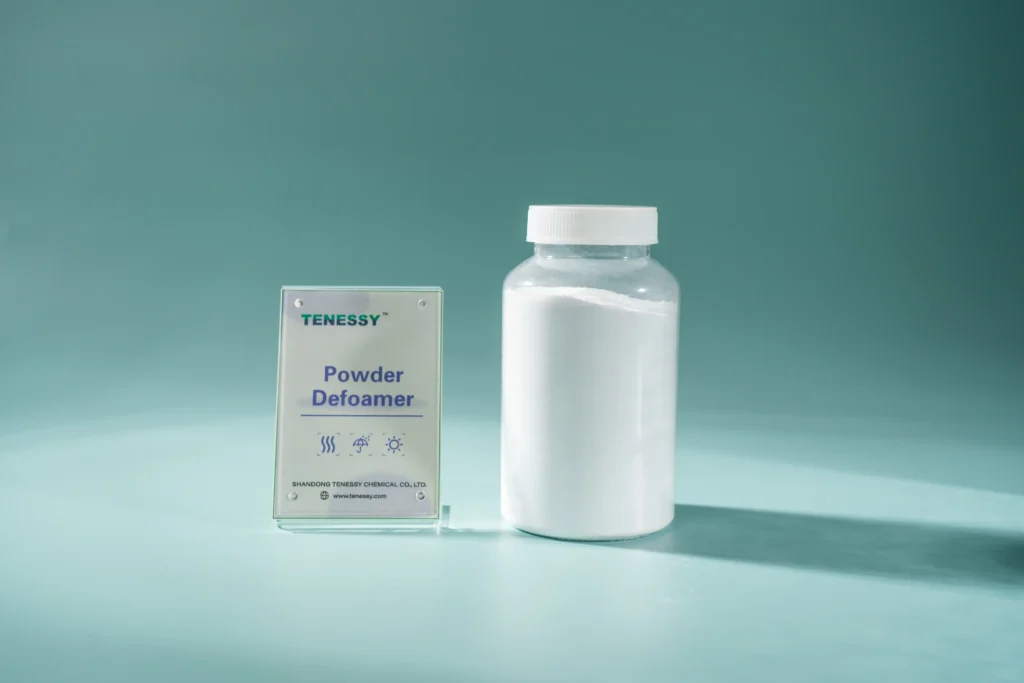
- Powder defoamer (tributyl phosphate-based or silicone-based) at 0.1–0.3%: breaks the air bubbles that HPMC has stabilized.
The interaction logic: PCE gives flow, HPMC gives stability, defoamer removes the air that both of them help entrain. In practice, the formulation is optimized in the flow cone: measure spread per ASTM C230 / EN 12706 flow cone (target typically 180–220 mm), and the number of pinholes after set. If pinholes persist, raise defoamer slightly or drop HPMC — but never delete HPMC, or you get bleeding instead of pinholes. If the surface “waves” or doesn’t self-level, reduce HPMC or lower its viscosity.
Order of addition in the dry blend matters: interleave HPMC, defoamer, and PCE (which in dry form is a spray-dried powder) so all three distribute uniformly through the sand-filler matrix. Poor dry-blend uniformity is the hidden cause of patchy pinhole patterns.
Common Defects and Fixes in Self-Leveling
Defect | Root cause | Fix |
Pinholes / craters on surface | Air bubbles not removed before set; defoamer too weak or mismatched | Increase powder defoamer to 0.2–0.3%; confirm HPMC is low-viscosity (≤ 1000 mPa·s); mix 2–3 min then let slurry de-aerate |
Bleeding / water layer on top | Not enough viscosity in water phase; particles settling | Increase HPMC to 0.1–0.15%; raise viscosity to 600–1000 mPa·s; check for overdosed PCE |
Does not self-level / stays “lumpy” | HPMC too viscous or overdosed; water too low | Switch to 400–600 mPa·s grade; reduce dosage to 0.05–0.08%; check water addition vs. flow cone |
Surface too soft / dusts | Overdosed HPMC retarding set; too much water | Cut HPMC toward 0.05%; reduce water; check ambient temperature |
Sand settles to bottom (heavy segregation) | HPMC absent or too low viscosity | Add 0.05–0.1% HPMC; increase to 600–1000 mPa·s grade |
Curling at edges / weak bond | Water sucked out by dry porous subfloor | Prime subfloor; increase HPMC dose slightly for retention; ensure proper surface prep |
One systemic rule: test at real site temperatures. Low-viscosity HPMC systems are more sensitive to cold weather — below 10 °C, setting slows and bleeding tendencies rise. In hot climates, evaporation accelerates and the small HPMC dose must work harder, so the 0.1–0.15% end of the range is usually right.
How to Formulate and Validate Your SLC
- Start with the binder skeleton. Select cement type (OPC 42.5R/52.5 or special SLC cement) and filler (fine silica sand ≤ 0.5 mm). Establish the base flow with PCE alone.
- Add HPMC at 0.08% (400–800 mPa·s). Measure flow cone spread, setting time, and bleeding. Adjust in 0.02% steps.
- Balance with defoamer. Start at 0.2%. Pour test slabs, evaluate pinhole count after 24 h. Fine-tune defoamer vs. HPMC.
- Validate to standards. Flow cone spread (EN 12706), setting time (EN 13454 or ASTM C191), compressive strength at 1/28 days, surface hardness, and shrinkage (EN 13454-2).
- Order free samples and repeat. TENESSY offers 500–3000 g free samples with COA so you can iterate without a full container commitment. When production-ready, our lead time is 7–14 days, with formulation support on call.
FAQ
Can I use the same HPMC in self-leveling compound as in tile adhesive?
What is the HPMC dosage in self-leveling compound?
Why does my self-leveling surface have pinholes?
Does HPMC retard the setting of self-leveling compound?
Should HPMC be added to the water or the dry mix?
Conclusion
HPMC for self-leveling compound is a precision tool: a low-viscosity (400–1000 mPa·s) cellulose ether dosed at 0.05–0.15% that stabilizes bubbles, prevents bleeding and settling, and controls water loss — all without compromising the fluidity that defines a self-leveling system. Balanced against a polycarboxylate superplasticizer for flow and a defoamer for air removal, it is the difference between a mirror-flat floor and a pinhole-riddled reject. TENESSY Chemical supplies construction-grade HPMC and PCE to SLC producers in 40+ countries, with free 500–3000 g samples, formulation guidance, and a 7–14 day production lead time. Send us your current recipe and defect photos — we’ll recommend the grade and dose.
Recommended Products: HPMC | PCE | Powder Defoamer