English
  Arabic
  German
  French
  Indonesian
  Russian
  Italian
  Czech
Czech  Dutch
Dutch  Finnish
  Turkish
  Greek
Greek  Spanish
  Portuguese
 HPMC water retention is the property that makes modern cement-based dry-mix products reliable — the reason a tile adhesive holds water against a thirsty slab, a render stays workable in the sun, and a putty cures hard instead of dusting. Understanding the physical chemistry behind it — hydrogen bonding, gel network formation, and viscosity-driven resistance — tells you exactly why viscosity, dosage, temperature, and cement type all shift the result, and why one grade cannot serve every season. This guide explains the mechanism, the influencing factors, and the standard test methods that quantify it.

Introduction
Water retention is defined practically as the ability of a fresh mortar to resist losing its mixing water when exposed to suction or evaporation. In cement-based systems it is not a luxury — it is the precondition for proper hydration. If a mortar gives up its water to the substrate or the air before the cement has hydrated, the result is a weak, dusty, poorly bonded material no matter how strong the dry formula looks on paper. This is why HPMC water retention sits at the center of nearly every dry-mix formulation discussion.
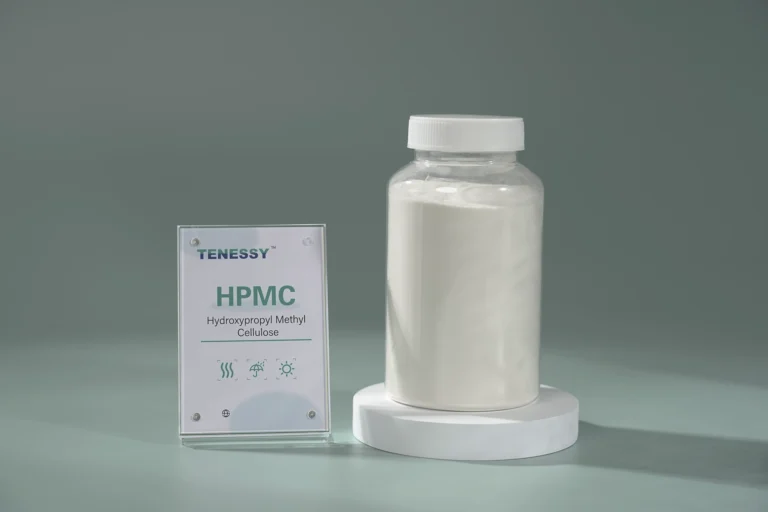
Hydroxypropyl methyl cellulose (HPMC) is the most widely used water-retention additive in building chemistry because it combines strong retention with controllable rheology at low cost. At TENESSY Chemical, where we manufacture construction-grade HPMC for mortar, adhesive, and putty producers in 40+ countries, water retention is the first specification we validate on every batch — and the first thing that changes when a customer moves to a new cement source, a hotter climate, or a thinner application. This article breaks the mechanism down to the molecular level and translates it into formulation decisions.
The Physical-Chemical Mechanism of HPMC Water Retention
HPMC retains water through three simultaneous, additive mechanisms:
1. Hydrogen bonding with water molecules.** The cellulose ether backbone carries hydroxyl (–OH), methoxy (–OCH₃), and hydroxypropoxy (–OCH₂CH(OH)CH₃) groups. The hydroxyl groups form hydrogen bonds with water molecules, and in solution the polymer is heavily hydrated — each repeating unit binds a shell of water. This is the first, weakest layer of retention: bound water that resists being pulled away at the molecular level.
2. Three-dimensional gel network (entanglement).** As HPMC dissolves, its long polymer chains entangle into a transient three-dimensional network. Water molecules are physically trapped inside the mesh of the network — mechanically, not just chemically. The network behaves like a weak gel: it has a yield stress, it resists deformation, and it slows any net movement of the solvent through it. This entanglement is the dominant retention mechanism at working dosages, and it scales directly with molecular weight — which is why viscosity (a proxy for molecular weight) is the primary grade selector.
3. Viscosity-driven capillary resistance.** The dissolved polymer raises the viscosity of the pore solution in the mortar. Darcy-type flow through the capillary network is inversely proportional to fluid viscosity, so the thicker the pore solution, the slower water migrates toward the substrate’s suction and the slower it evaporates from the surface. The gel film that forms at the mortar-substrate interface also partially blocks the capillary mouths — a “self-sealing” effect.
The three mechanisms reinforce each other: hydrogen bonding hydrates the chains, hydration drives entanglement, and entanglement raises viscosity. Remove any one and retention drops measurably — which is why low-molecular-weight (low-viscosity) HPMC grades show weaker retention and why overdilution in the mix always hurts.
Factors That Control Water Retention
**Viscosity of the HPMC grade.** Retention climbs with solution viscosity up to a plateau around 40000–100000 mPa·s (2% solution), after which the gain flattens. A 20000 mPa·s grade might deliver 85% retention at 0.3%; a 100000 grade at the same dose reaches 92–95%. Above the plateau, you pay for viscosity you don’t need.
**Dosage.** Retention rises steeply from 0 to about 0.3%, then curves off. The practical engineering rule: choose the dosage that reaches your target retention (≥ 85% for adhesives, ≥ 90% for C2 products, ≥ 85% for putty) and stop — overdosing buys retardation and air without meaningful retention gain.
**Cement type and fineness.** Portland cement with higher C₃A content and finer grind demands more water and hydrates faster; the mortar’s internal water demand competes with substrate suction, so retention must be measured with the actual cement, not a generic assumption. Slag and pozzolanic blends change the particle-size distribution and pore structure of the paste, shifting retention behavior — re-test when you change cement source.
**Temperature.** This is the factor customers underestimate most. Retention is measured and quoted at 20 °C, but real job sites run from 5 °C to 45 °C. High temperature does three things: it lowers the viscosity of the HPMC solution (thermal thinning), it speeds evaporation, and it accelerates cement hydration — all of which reduce effective retention. Low temperature has the opposite effect: retention is easier, but hydration and set are slow, so over-retention delays the schedule.
**Substrate porosity and suction.** The retained-water test only has meaning against a defined substrate suction. Higher-suction substrates (dry block, lime sand) pull harder than low-suction ones (wet concrete, insulation board), so a mortar optimized for one surface may under-perform on another. Test against the worst-case substrate in your market.
**Water-cement ratio and mixing.** Excess mixing water dilutes the HPMC network and lowers retention per unit water. A mortar mixed at 0.45 w/c retains more of its water than the same formula at 0.55 w/c, even though the absolute water loss may be similar.
Measuring Water Retention: EN 413-2 and the Filter-Paper Method
The standard way to quantify HPMC water retention in cement-based materials is a suction test — most commonly the filter-paper / vacuum method aligned with EN 413-2 (for masonry cement) and widely adapted for dry-mix mortars:
1. Prepare the fresh mortar at the specified water addition.
2. Weigh a sample into a ring mold of known dimensions (typically 80–100 mm diameter).
3. Place the mold on a stack of dry filter papers (e.g., 8–10 sheets) resting on a flat, sealed plate.
4. Apply a defined load/suction for a fixed time (often 5–10 minutes).
5. Reweigh the mortar. Water retention = (water in mortar after suction) ÷ (water in mortar before suction) × 100%.
Typical results: mortar without HPMC retains 50–60%; with 0.2–0.4% HPMC, 85–95%. Reproducible results require tight control of filter-paper brand/count, applied load, and ambient temperature — and a consistent mixing protocol (EN 196-1 mixer, fixed speed and duration).
Related standards in the same family: EN 1015-8 (water retentivity of fresh mortar for masonry, measured by filter plate) and EN 459-2 (building lime). For self-leveling and adhesive systems, the same principle is applied with the vacuum-suction variation. When we ship HPMC to a customer, our COA includes viscosity, moisture, ash, and gelation temperature — and we routinely help customers set up the retention test in their own lab so their spec matches ours.
Temperature and Seasonal Grade Selection
Because retention falls as temperature rises, producers in seasonal climates must think in terms of two formulations — a practice TENESSY strongly supports:
| Condition | Recommendation | Why |
|—|—|—|
| Hot season / hot climate (30–45 °C) | Higher viscosity grade or +0.05–0.10% dosage; consider HEMC | Thermal thinning + faster evaporation + faster hydration all reduce retention; HEMC’s higher gelation temperature keeps the gel network stable above 40 °C |
| Cold season (5–15 °C) | Keep dosage at the low tested end; lower viscosity OK | Retention is naturally easier when cold; excess HPMC retards the already-slow set |
| Moderate climate | Standard grade and mid-dosage | 20 °C reference conditions apply |
| Hot + highly porous substrate | Highest viscosity in range + tested dosage | Combine both stress factors |
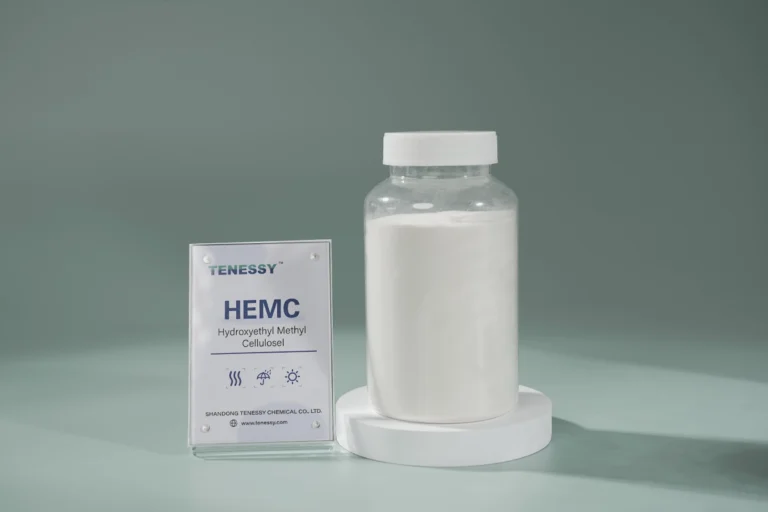
**Why HEMC wins in heat.** Hydroxyethyl methyl cellulose has a higher gelation temperature (roughly 70–90 °C) than typical HPMC (58–64 °C). In a mortar sitting at 40–50 °C on a summer roof, HPMC’s gel network partially collapses as it approaches its cloud point, and retention drops sharply. HEMC keeps its network intact, which is why many of our Middle Eastern and African customers run HEMC in summer and HPMC in winter. The measurable difference is water retention on the filter-paper test at 40 °C: HEMC-grade systems typically hold 5–10 percentage points more than HPMC equivalents in that regime.
The practical rule we give customers: **measure retention at the temperature your product will actually see, not at 20 °C.** If you can’t, keep a safety margin in dosage and switch to HEMC above 35 °C ambient.
How to Validate Water Retention in Your Formulation
1. **Establish your retention target.** ≥ 85% for general dry-mix mortars and putties; ≥ 90% for C2 tile adhesive and exterior renders.
2. **Select grade and dose** from our application tables (viscosity 40000–100000 mPa·s for most mortars; 400–1000 for self-leveling).
3. **Run the filter-paper test at 20 °C and at your worst-case site temperature.** Record both numbers.
4. **Test against your actual substrate.** Use the most absorbent block or concrete you expect in the field.
5. **Compare batches.** When your COA viscosity moves by more than 10%, expect measurable retention drift — flag it before it reaches the field.
6. **Order free samples and benchmark.** TENESSY supplies 500–3000 g free samples with COA so you can lock your retention spec against our production material. Lead time for production is 7–14 days.
FAQ
Q1: What is the water retention mechanism of HPMC?
A: HPMC retains water through three additive mechanisms: hydrogen bonding between the polymer’s hydroxyl groups and water molecules, physical entrapment of water inside the entangled polymer gel network, and a viscosity rise in the pore solution that slows capillary flow and evaporation. The gel network is the dominant factor at working dosages, which is why higher-viscosity grades retain more water.
Q2: How is HPMC water retention tested?
A: By suction methods such as the filter-paper test per EN 413-2: a fresh mortar sample in a ring mold sits on dry filter papers under a defined load for a fixed time, and water retention is the percentage of mixing water retained after suction. EN 1015-8 is the equivalent standard for masonry mortars. Consistent mixing, load, and paper quality are essential for reproducible numbers.
Q3: Does higher HPMC viscosity always mean higher water retention?
A: Up to a plateau, yes. Retention climbs with viscosity (molecular weight) until roughly 40000–100000 mPa·s, then gains flatten sharply. Beyond that plateau you add cost and retardation without meaningful retention improvement. Dosage also saturates near 0.3–0.4%; after that the curve is flat.
Q4: Why does my mortar lose retention in summer?
A: High temperature thins the HPMC solution, accelerates evaporation, and speeds cement hydration — all three cut effective retention. Solutions: raise dosage by 0.05–0.10%, move to a higher-viscosity grade, or switch to HEMC, whose higher gelation temperature keeps the gel network intact above 40 °C.
Q5: Can HPMC water retention be too high?
A: Yes. Over-retention (typically from overdosing in cold or wet conditions) delays setting, slows drying, and can leave surfaces sticky or soft. Retention should be engineered to the minimum that meets hydration and workability targets — usually 85–90% — not maximized for its own sake.
Conclusion
HPMC water retention is a three-part physical mechanism — hydrogen bonding, gel-network entrapment, and viscosity-driven capillary resistance — and every factor that perturbs it (grade viscosity, dosage, cement type, substrate suction, and above all temperature) is a formulation variable you must control. Test at your real site temperature, against your real substrate, with the EN 413-2 / EN 1015-8 methods, and keep a seasonal grade strategy: HPMC for moderate climates, HEMC for the heat. TENESSY Chemical manufactures both on German-engineered lines, exports to 40+ countries, and supports customers with free 500–3000 g samples, COA-backed batch consistency, and a 7–14 day production cycle. Send us your retention test data — we will help you interpret it and tune the formula.
**Recommended Products:** [HPMC](https://tenessy.com/products/hpmc-hydroxypropyl-methyl-cellulose/) | [HEMC](https://tenessy.com/products/hemc-hydroxyethyl-methyl-cellulose/)
**Related Reading:** [What Is HPMC? A Complete Guide](https://tenessy.com/what-is-hpmc-construction/) | [HPMC in Cement Plaster](https://tenessy.com/hpmc-in-cement-plaster/)