English
  Arabic
  German
  French
  Indonesian
  Russian
  Italian
  Czech
Czech  Dutch
Dutch  Finnish
  Turkish
  Greek
Greek  Spanish
  Portuguese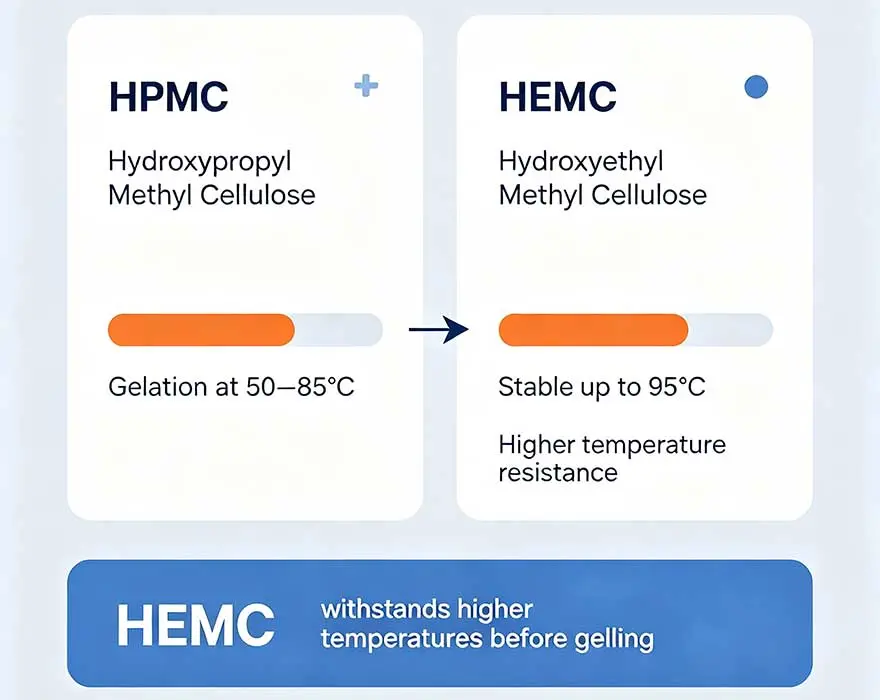
The main difference between HPMC and HEMC is thermal stability: HEMC (Hydroxyethyl Methyl Cellulose) withstands higher temperatures before gelling, while HPMC (Hydroxypropyl Methyl Cellulose) gels at a lower temperature range. TENESSY HPMC has a gel temperature of 54–64°C (standard type) or 70–90°C (high-temperature type). HEMC offers superior high-temperature adaptability, making it the preferred choice for hot-climate construction and high-temperature applications. For general construction at moderate temperatures, HPMC offers equivalent performance at a lower cost.
Both are non-ionic cellulose ethers used as thickeners, water retention agents, and film formers in construction, coatings, and personal care. Understanding their differences helps formulators and procurement teams select the optimal material for each application.
What Is HPMC?
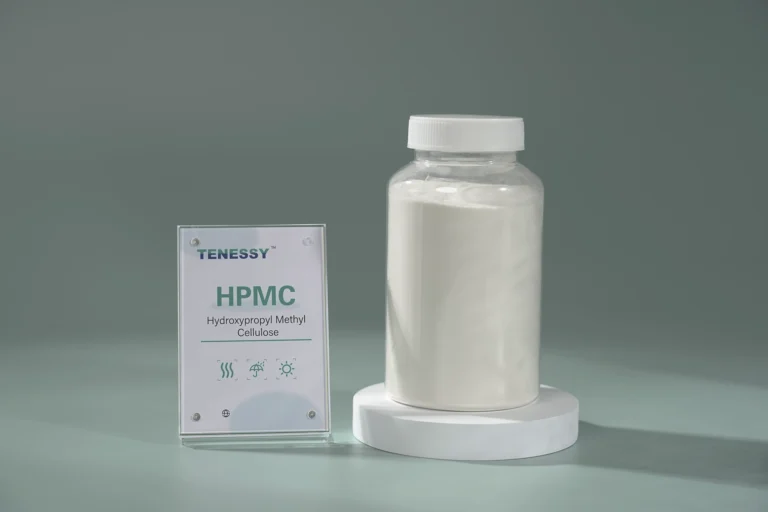
HPMC (Hydroxypropyl Methyl Cellulose) is a non-ionic cellulose ether produced by treating natural cellulose with propylene oxide and methyl chloride. It is the most widely used cellulose ether in construction applications due to its excellent water retention, thickening, workability improvement, and cost-effectiveness.
CAS Number: 9004-65-3 Key properties: Water retention, thickening, film formation, enzyme resistance Gel temperature: 54–64°C (standard, 60°C) / 70–90°C (high-temp type, 75°C) Viscosity range: 10–80,000 mPa·s (2%, 20°C, Brookfield RV) / 10–200,000 mPa·s (2%, 20°C, NDJ-1)
TENESSY HPMC Grade Series:
- NH Series (non-instant, construction): NH200PC, NH150PC, NH100PC, NH2000, NH1500, NH1200, NH1000, NH400Z, NH200T
- NS Series (surface-treated, daily chemicals): NS200PC, NS150PC, NS100PC
What Is HEMC?
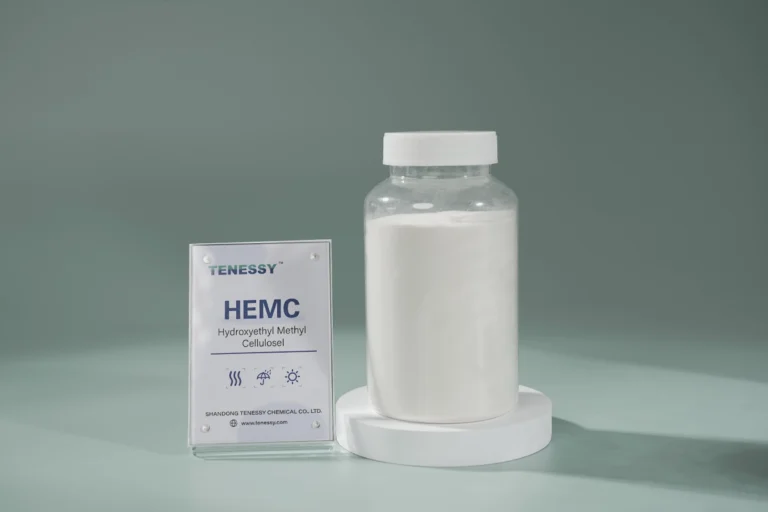
HEMC (Hydroxyethyl Methyl Cellulose), also known as MHEC, is a non-ionic cellulose ether produced by treating cellulose with ethylene oxide and methyl chloride. Its chemical structure includes hydroxyethyl groups that provide superior thermal stability compared to HPMC.
CAS Number: 9032-42-2 Key properties: High thermal stability, water retention, thickening, excellent workability Viscosity range: 5–80,000 mPa·s (2%, 20°C, Brookfield RV) / 5–200,000 mPa·s (2%, 20°C, NDJ-1) TENESSY HEMC grades: NE Series, including NE200K for water-based latex coatings and construction
The 5 Key Differences
1. Thermal Stability and Gel Temperature
Property | HPMC | HEMC |
Gel temperature (TENESSY spec) | 54–64°C (standard) / 70–90°C (high-temp) | Higher than HPMC — resists high temperatures |
Performance at 40°C | Good | Good |
Performance at 60°C | Standard type begins to gel | Stable |
Performance at 80°C | Gelled (loses viscosity) | Stable |
Best for | Moderate climates | Hot climates, summer construction |
Why this matters: When cellulose ether solutions exceed their gel temperature, the polymer precipitates and loses its thickening and water-retention properties. In summer construction in the Middle East, South Asia, or tropical regions where mortar temperatures can exceed 60°C, standard HPMC may gel prematurely, leading to poor workability and reduced water retention. HEMC maintains performance under these conditions.
2. Water Retention
Both HPMC and HEMC provide excellent water retention in cement-based and gypsum-based systems. According to TENESSY’s product specifications, HEMC has stronger water retention, viscosity stability, mildew resistance, and dispersibility compared with HPMC.
- HPMC: Excellent water retention at moderate temperatures (20–40°C)
- HEMC: Maintains water retention at elevated temperatures where HPMC begins to lose effectiveness; also offers stronger mildew resistance
For standard construction conditions (10–35°C), the water retention difference is negligible. The distinction becomes critical in hot-weather concreting and plastering.
3. Workability and Open Time
Aspect | HPMC | HEMC |
Initial workability | Excellent | Excellent |
Open time at moderate temp | Long | Long |
Open time at high temp | Reduced | Maintained |
Sag resistance | Very good | Very good |
High-temperature adaptability | Good (standard type) / Very good (high-temp type) | Excellent |
HEMC generally provides slightly longer open time and better workability retention in hot conditions, which is why it is preferred by many dry-mix mortar manufacturers in warm-climate markets. TENESSY HEMC features good anti-sagging effect, long open time, and high early strength.
4. Cost and Availability
Factor | HPMC | HEMC |
Market price | Lower | Higher |
Global production volume | Higher (more widely produced) | Lower (fewer manufacturers) |
Grade availability | Extensive (9 NH grades + 3 NS grades at TENESSY) | Good (NE Series at TENESSY) |
HPMC’s larger production scale and broader supplier base make it more cost-effective for applications where thermal stability is not a critical factor. TENESSY produces 6,000 tons of cellulose ether annually, with 52% being HPMC.
5. Application Suitability
Application | Recommended | TENESSY Grade Examples | Reason |
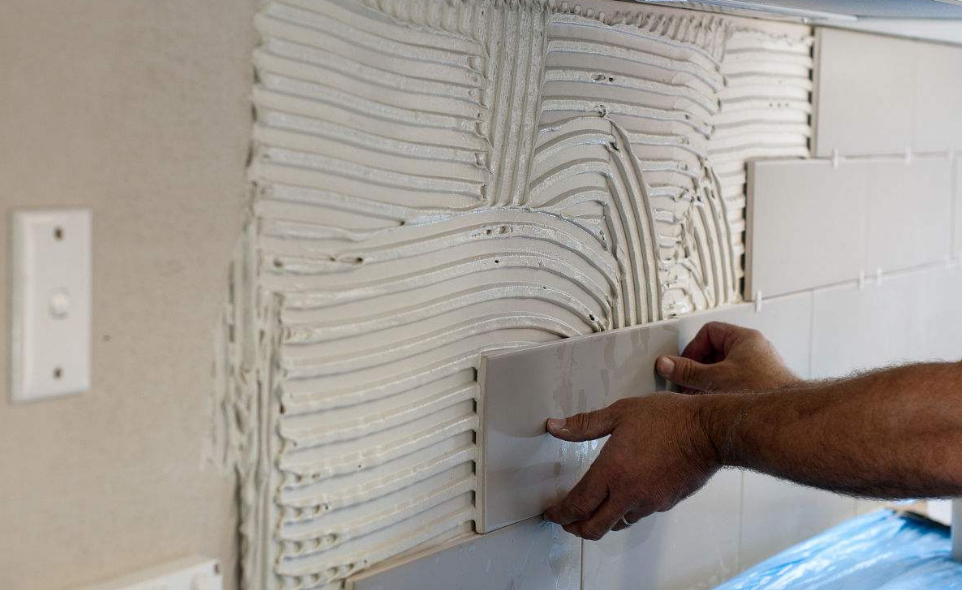
Tile adhesive (moderate climate) | HPMC | NH200PC, NH150PC | Cost-effective, excellent performance |
Tile adhesive (hot climate) | HEMC | NE Series | Thermal stability prevents premature gel |
Wall putty / skim coat | HPMC | NH100PC, NH2000, NH1500 | Standard conditions, cost-effective |
Dry-mix mortar (summer/tropical) | HEMC | NE Series | Maintains workability in heat |
Self-leveling compound | HPMC | NH200T, NH400Z | Specifically designated for self-leveling |
Gypsum plaster | HPMC | NH2000, NH1500 | Good compatibility, cost-effective |
Exterior insulation (ETICS) | HEMC | NE Series | Exterior heat exposure |
Waterproof mortar | HPMC | NH150PC | Designated for waterproof mortar |
Detergent/cleaner | HPMC | NS100PC, NS150PC, NS200PC | NS Series for daily chemicals |
Coatings | HEMC | NE200K | Designated for water-based latex coatings |
How to Choose: Decision Framework
Use this simple decision tree to select between HPMC and HEMC:
- Will the application involve temperatures above 60°C?
- Yes → Choose HEMC
- No → Continue
- Is the project in a hot-climate region (Middle East, South Asia, tropical zones)?
- Yes → Choose HEMC for exterior applications
- No → Continue
- Is this a coating or paint application?
- Yes → Consider HEMC (NE200K is designated for water-based latex coatings)
- No → Continue
- Is this a daily chemical or cosmetic application?
- Yes → Choose HPMC NS Series (NS100PC, NS150PC, NS200PC)
- No → Continue
- Is cost a primary concern?
- Yes → Choose HPMC NH Series
- No → Consider HEMC for superior open time and thermal adaptability
Can HPMC and HEMC Be Used Together?
Yes. Many advanced dry-mix mortar formulations blend HPMC and HEMC to achieve optimal performance across temperature ranges. A typical blend ratio is 70:30 or 50:50 (HPMC:HEMC), providing cost efficiency with improved thermal stability. Our technical team can help optimize blend ratios for specific formulations.