Portuguese
  English
  Arabic
  German
  French
  Indonesian
  Russian
  Italian
  Czech
Czech  Dutch
Dutch  Finnish
  Turkish
  Greek
Greek  Spanish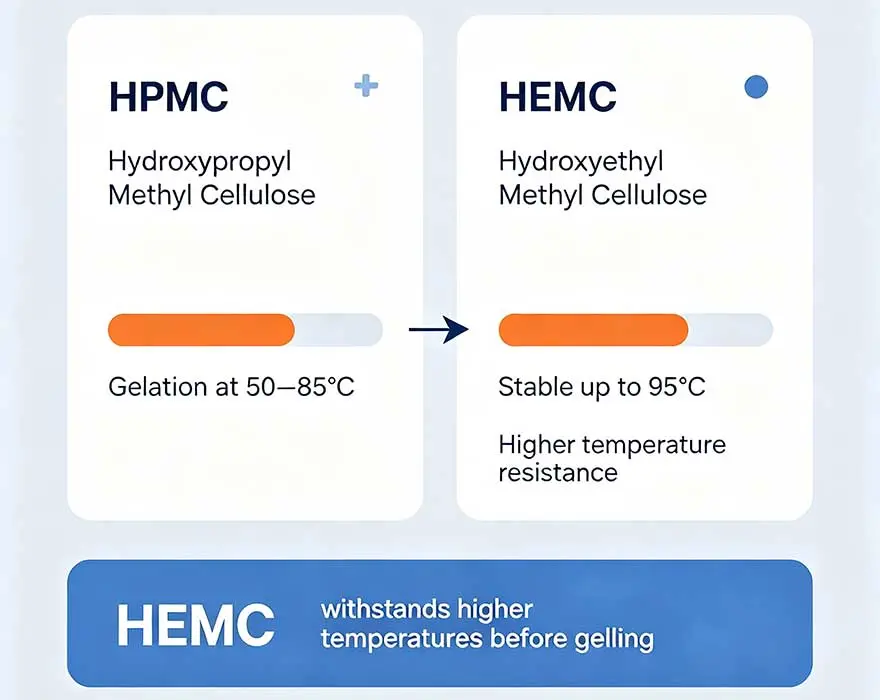
A principal diferença entre o HPMC e o HEMC é a estabilidade térmica: A HEMC (hidroxietilmetilcelulose) suporta temperaturas mais altas antes de gelificar, enquanto a HPMC (hidroxipropilmetilcelulose) gelifica em uma faixa de temperatura mais baixa. A HPMC da TENESSY apresenta uma temperatura de gelificação de 54–64 °C (tipo padrão) ou 70–90 °C (tipo para altas temperaturas). A HEMC oferece adaptabilidade superior a altas temperaturas, tornando-a a escolha preferida para construções em climas quentes e aplicações em altas temperaturas. Para obras em geral em temperaturas moderadas, o HPMC oferece desempenho equivalente a um custo menor.
Ambos são éteres de celulose não iônicos utilizados como espessantes, agentes de retenção de água e formadores de filme nos setores da construção, revestimentos e cuidados pessoais. Compreender suas diferenças ajuda os formuladores e as equipes de compras a selecionar o material ideal para cada aplicação.
O que é HPMC?
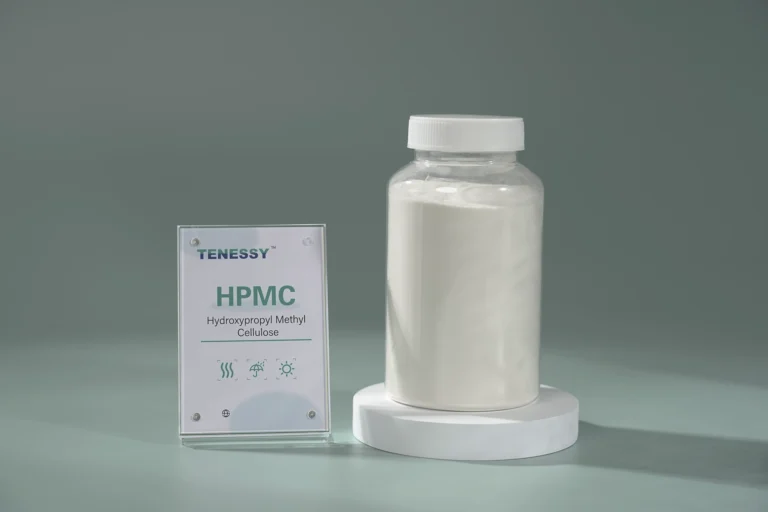
HPMC (hidroxipropilmetilcelulose) é um éter de celulose não iônico produzido pelo tratamento da celulose natural com óxido de propileno e cloreto de metila. É o éter de celulose mais utilizado em aplicações da construção civil devido à sua excelente retenção de água, capacidade de espessamento, melhoria da trabalhabilidade e boa relação custo-benefício.
Número CAS: 9004-65-3 Principais características: Retenção de água, espessamento, formação de película, resistência enzimática Temperatura do gel: 54–64 °C (padrão, 60 °C) / 70–90 °C (tipo de alta temperatura, 75 °C) Faixa de viscosidade: 10–80.000 mPa·s (2%, 20 °C, Brookfield RV) / 10–200.000 mPa·s (2%, 20 °C, NDJ-1)
Série TENESSY HPMC:
- Série NH (não instantâneo, para construção): NH200PC, NH150PC, NH100PC, NH2000, NH1500, NH1200, NH1000, NH400Z, NH200T
- Série NS (produtos com tratamento de superfície, produtos químicos de uso diário): NS200PC, NS150PC, NS100PC
O que é o HEMC?
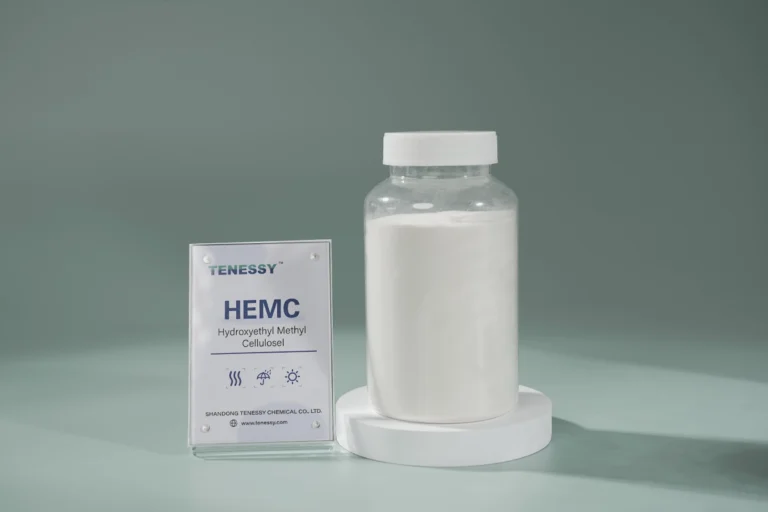
HEMC (hidroxietilmetilcelulose), também conhecido como MHEC, é um éter de celulose não iônico produzido pelo tratamento da celulose com óxido de etileno e cloreto de metila. Sua estrutura química inclui grupos hidroxietílicos que proporcionam uma estabilidade térmica superior em comparação com o HPMC.
Número CAS: 9032-42-2 Principais características: Alta estabilidade térmica, retenção de água, espessamento, excelente trabalhabilidade Faixa de viscosidade: 5–80.000 mPa·s (2%, 20 °C, Brookfield RV) / 5–200.000 mPa·s (2%, 20 °C, NDJ-1) Classificações do TENESSY HEMC: Série NE, incluindo NE200K para revestimentos de látex à base de água e para a construção civil
As 5 principais diferenças
1. Estabilidade térmica e temperatura do gel
Propriedade | HPMC | HEMC |
Temperatura do gel (especificação TENESSY) | 54–64 °C (padrão) / 70–90 °C (alta temperatura) | Mais resistente do que o HPMC — resiste a altas temperaturas |
Desempenho a 40 °C | Bom | Bom |
Desempenho a 60 °C | O modelo padrão começa a tomar forma | Estável |
Desempenho a 80 °C | Gelificado (perde viscosidade) | Estável |
Ideal para | Climas moderados | Climas quentes, obras no verão |
Por que isso é importante: Quando as soluções de éter de celulose ultrapassam sua temperatura de gelificação, o polímero se precipita e perde suas propriedades de espessamento e retenção de água. Em obras realizadas no verão no Oriente Médio, no Sul da Ásia ou em regiões tropicais, onde as temperaturas da argamassa podem ultrapassar 60 °C, o HPMC padrão pode gelificar prematuramente, resultando em baixa trabalhabilidade e retenção de água reduzida. O HEMC mantém seu desempenho nessas condições.
2. Retenção de água
Tanto o HPMC quanto o HEMC proporcionam excelente retenção de água em sistemas à base de cimento e gesso. De acordo com as especificações do produto da TENESSY, o HEMC apresenta maior retenção de água, estabilidade de viscosidade, resistência ao mofo e dispersibilidade em comparação com o HPMC.
- HPMC: Excelente retenção de água em temperaturas moderadas (20–40 °C)
- HEMC: Mantém a retenção de água em temperaturas elevadas, nas quais o HPMC começa a perder eficácia; além disso, oferece maior resistência ao mofo
Em condições normais de construção (10–35 °C), a diferença na retenção de água é insignificante. Essa diferença torna-se crítica em trabalhos de concretagem e reboco realizados em climas quentes.
3. Trabalhabilidade e tempo de abertura
Aspecto | HPMC | HEMC |
Trabalhabilidade inicial | Excelente | Excelente |
Tempo de cozimento em temperatura moderada | Longo | Longo |
Tempo de abertura em alta temperatura | Reduzido | Atualizado |
Resistência à deformação | Muito bom | Muito bom |
Adaptabilidade a altas temperaturas | Bom (tipo padrão) / Muito bom (tipo para altas temperaturas) | Excelente |
O HEMC geralmente oferece um tempo aberto um pouco mais longo e melhor retenção da trabalhabilidade em condições de calor, razão pela qual é o produto preferido por muitos fabricantes de argamassas pré-misturadas em mercados de clima quente. O TENESSY HEMC apresenta bom efeito anti-afundamento, longo tempo aberto e alta resistência inicial.
4. Custo e disponibilidade
Fator | HPMC | HEMC |
Preço de mercado | Mais baixo | Mais alto |
Volume de produção global | Mais elevado (produzido em maior escala) | Menor (menos fabricantes) |
Disponibilidade de séries | Amplo (9 séries do NH + 3 séries do NS no TENESSY) | Bom (Série NE no TENESSY) |
A maior escala de produção do HPMC e sua base de fornecedores mais ampla tornam esse produto mais econômico para aplicações em que a estabilidade térmica não é um fator crítico. A TENESSY produz 6.000 toneladas de éter de celulose por ano, sendo que o 52% é o HPMC.
5. Adequação da aplicação
Aplicativo | Recomendado | Exemplos de notas do TENESSY | Motivo |
Adesivo para azulejos (clima moderado) | HPMC | NH200PC, NH150PC | Custo-benefício, excelente desempenho |
Adesivo para azulejos (clima quente) | HEMC | Série NE | A estabilidade térmica evita a gelificação prematura |
Massa para parede / camada de acabamento | HPMC | NH100PC, NH2000, NH1500 | Condições padrão, com boa relação custo-benefício |
Argamassa pronta para uso (verão/tropical) | HEMC | Série NE | Mantém a maleabilidade em condições de calor |
Composto autonivelante | HPMC | NH200T, NH400Z | Especificamente projetado para autonivelamento |
Gesso | HPMC | NH2000, NH1500 | Boa compatibilidade, boa relação custo-benefício |
Isolamento externo (ETICS) | HEMC | Série NE | Exposição ao calor externo |
Argamassa à prova d'água | HPMC | NH150PC | Indicado para argamassa impermeável |
Detergente/produto de limpeza | HPMC | NS100PC, NS150PC, NS200PC | Série NS para produtos químicos de uso diário |
Revestimentos | HEMC | NE200K | Indicado para revestimentos de látex à base de água |
Como escolher: Estrutura de decisão
Use esta árvore de decisão simples para escolher entre HPMC e HEMC:
- A aplicação envolverá temperaturas acima de 60 °C?
- Sim → Escolha HEMC
- Não → Continuar
- O projeto está localizado em uma região de clima quente (Oriente Médio, Sul da Ásia, zonas tropicais)?
- Sim → Escolha o HEMC para aplicações externas
- Não → Continuar
- Trata-se de um revestimento ou de uma aplicação de tinta?
- Sim → Considere o HEMC (o NE200K é indicado para revestimentos de látex à base de água)
- Não → Continuar
- Trata-se de uma aplicação diária de produto químico ou cosmético?
- Sim → Escolha a série HPMC NS (NS100PC, NS150PC, NS200PC)
- Não → Continuar
- O custo é uma das principais preocupações?
- Sim → Escolha a série HPMC NH
- Não → Considere o HEMC para obter tempo de abertura superior e maior adaptabilidade térmica
É possível usar HPMC e HEMC juntos?
Sim. Muitas formulações avançadas de argamassa seca combinam HPMC e HEMC para alcançar um desempenho ideal em diversas faixas de temperatura. Uma proporção típica de mistura é 70:30 ou 50:50 (HPMC:HEMC), proporcionando economia e maior estabilidade térmica. Nossa equipe técnica pode ajudar a otimizar as proporções de mistura para formulações específicas.