English
  Arabic
  German
  French
  Indonesian
  Russian
  Italian
  Czech
Czech  Dutch
Dutch  Finnish
  Turkish
  Greek
Greek  Spanish
  Portuguese
 PCE in self-compacting concrete is the essential ingredient that delivers the perfect balance of high fluidity and cohesion — letting SCC flow into formwork and around reinforcement without any vibration. This guide explains why polycarboxylate superplasticizer is uniquely suited to SCC, how to design the mix, how to dose and adjust PCE, and how to prevent segregation and bleeding.
Introduction
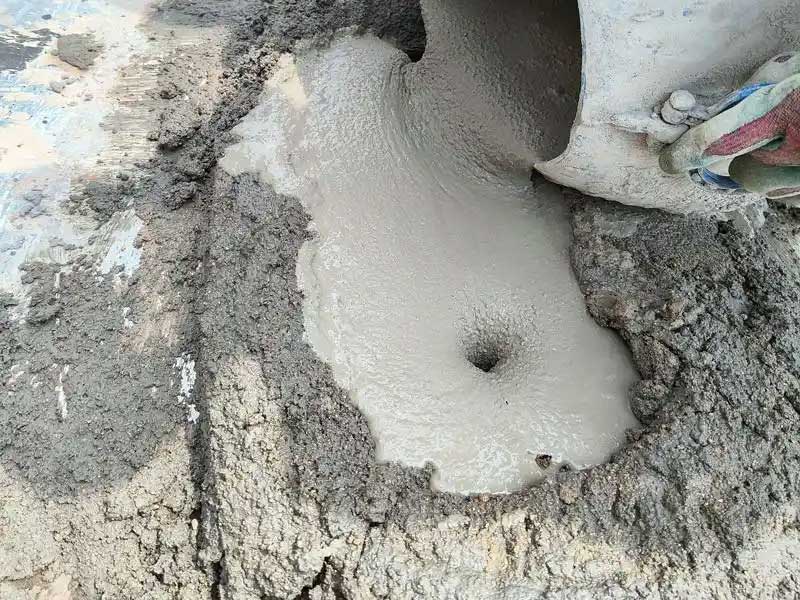
Self-compacting concrete (SCC) does not just save labor — it makes better structures. Because it flows into place under its own weight, it reaches every corner of complex formwork, packs around dense reinforcement, and eliminates the honeycombing and voids that vibration-dependent concrete suffers in congested sections. Developed in Japan in the late 1980s in response to a shortage of skilled vibrator operators, SCC is now standard practice for high-rise cores, tunnel linings, precast elements, and architectural concrete worldwide.
But SCC asks the mix designer to satisfy two opposing demands at once: fluid enough to flow and self-level, yet cohesive enough that the coarse aggregate never settles out. The answer is a low water-to-powder ratio, a carefully graded aggregate skeleton, and a superplasticizer that fluidizes the mix at very low water content. PCE in self-compacting concrete is that superplasticizer — its 25–40% water reduction and long slump retention make it, in practice, the only chemistry that delivers SCC reliably. This article covers why, and how to dose it.
Why SCC Demands PCE: Fluidity, Cohesion, and Stability
The SCC Working Window
A conventional vibrated concrete tolerates a wide range of workability because the vibration energy compensates for lack of flow. SCC has no such tolerance. It must be engineered into a narrow working window defined by three properties, all measured by standard tests:
- Filling ability (spread): Measured by the slump flow test (EN 12350-8 / ASTM C1611). Typical SCC spreads 600–750 mm; below ~550 mm it is not self-compacting.
- Passing ability: Measured by the L-box, U-box, or J-ring tests — the mix must pass through narrow gaps between bars without blocking.
- Segregation resistance (stability): Measured by the sieve segregation test (EN 12350-11). Loss at the 5 mm sieve should stay below 15–20%.
The conflict is obvious: fluidity pushes toward more water and more fines (more paste), while stability pushes toward less water and a stiffer paste. PCE is the lever that resolves the conflict — it generates the fluidity at a water content low enough to keep the paste viscous and the mix stable.
The Role of PCE in the SCC System
In an SCC mix, every component has a job:
Component | Role in SCC |
Paste volume (cement + fillers + water + admixture) | 35–40% of total volume — enough to coat aggregates and carry them |
Powder (cement + limestone or other fillers) | 400–600 kg/m³ — provides cohesion and viscosity |
Water-to-powder ratio | 0.30–0.42 by volume — low enough for stability |
Coarse aggregate | ≤ 50% of solid volume, max size ≤ 20 mm — small enough to pass rebar |
PCE | Provides fluidity at low water; sustains flow over time |
Without PCE, reaching 650 mm slump flow at a water-to-powder ratio of 0.35 requires an unworkable overdose of powder or water — the former is uneconomical, the latter segregates. PCE decouples fluidity from water content: it disperses the cement so thoroughly that the same amount of water produces a much thinner paste. This is the physical basis of SCC.
Why Not PNS or Lignosulfonate?
The question naturally arises: could a cheaper superplasticizer do the job? The practical answer is no, for three reasons:
- Water reduction ceiling: PNS reaches only 15–25% — usually not enough for the low water-to-powder ratios where SCC stays stable.
- Slump flow loss: PNS loses workability within 30–60 minutes, and SCC must stay flowable through transport and placement.
- Retardation problems: Lignosulfonate’s strong retardation and modest water reduction disqualify it as the primary admixture, though it appears in some low-cost SCC variants.
PCE’s steric-hindrance mechanism (see our polycarboxylate superplasticizer guide) is insensitive to pore-solution ionic strength, so it keeps working at the very low w/c that SCC requires — something charge-based dispersants simply cannot do at the same dosage.
Mix Design and PCE Dosage for SCC
The Mix Design Process (in Brief)
SCC mix design starts with the paste and works outward:
- Set aggregate grading: Total aggregate 55–65% by volume, coarse aggregate ≤ 50% of aggregate volume, maximum size typically 16–20 mm.
- Choose the powder content: 400–600 kg/m³ of cement + fillers (limestone powder is the classic economical choice). The paste volume should be 35–40% of the mix.
- Set the water-to-powder ratio: Start at 0.35 by volume (0.32–0.38 typical). Adjust up if the mix is too dry, down if it segregates.
- Select the PCE grade: a high-water-reduction grade with 60–120 minutes retention; for long-haul hot-weather SCC, an ether-linked long-retention grade.
- Dose the PCE: Start at 0.15–0.20% active solids on powder and adjust in small steps.
PCE Dosage Range and Adjustment Rules
The working range for PCE in SCC is 0.15–0.30% active solids by weight of total powder (cement + mineral additions). A few practical rules:
- Start low, step small: Begin at 0.15%. Measure slump flow. Increase in 0.025–0.05% steps until the target spread (e.g., 650 mm) is reached. Overshooting by even 0.05% can flip the mix from stable to segregating.
- The dosage curve is steep: In SCC, a 0.05% change in PCE dosage typically changes slump flow by 50–150 mm. Small adjustments, long mixing cycles, and patience are the tools.
- Mixing time matters: PCE needs 2–4 minutes of high-shear mixing to fully disperse. Short mixing produces misleadingly low spread and invites overdosing.
- Watch the retention curve: Measure slump flow at 0, 30, 60, and 90 minutes. A good SCC keeps at least 80% of its initial spread at 60 minutes. If flow decays faster, either increase the dose, switch to a longer-retention grade, or check cement-PCE compatibility.
A Representative SCC Mix (indicative values per m³)
Ingredient | Quantity | Notes |
Cement (CEM I 42.5) | 350 kg | |
Limestone powder | 150 kg | Cohesion and paste volume |
Water | 180 L | Water-to-powder ≈ 0.36 |
Fine sand (0–2 mm) | 750 kg | |
Coarse aggregate (2–16 mm) | 800 kg | 50% of aggregate volume |
PCE (active solids) | 1.1–1.5 kg | ≈ 0.22–0.30% on powder |
VMA (if needed) | 0.1–0.3 L/m³ | Stabilizer for lean mixes |
Air entrainer (if required) | as needed | Freeze-thaw exposure |
Adjust the quantities to your local materials — the numbers are a starting point, not a recipe.
Common SCC Problems: Segregation, Bleeding, and How PCE Adjustment Fixes Them
Problem 1: Segregation
Symptom: Coarse aggregate settles at the bottom or in the flow direction, leaving mortar behind — detected by the sieve segregation test (loss > 20%) or visually during the slump flow test.
Causes: Too much water, too much PCE, insufficient powder content, or too-high coarse-aggregate volume.
Fixes, in order of preference:
- Reduce PCE slightly — the mix has more fluidity than it needs; the cheapest and most common fix.
- Reduce mixing water — if spread is still above target at a lower PCE dose.
- Increase powder content (limestone powder) — more paste, more viscosity, more aggregate-carrying capacity.
- Add a viscosity-modifying agent (VMA) — the robust option for stable but fluid SCC (see below).
- Reduce coarse aggregate volume — revisit the aggregate grading.
Problem 2: Bleeding
Symptom: A film of water appears on the surface after placement; paste is thin and the surface is weak.
Causes: Water-to-powder ratio too high, PCE overdosed, or a poorly tuned retention grade that releases water over time.
Fixes:
- Lower the water-to-powder ratio — 0.35 by volume is a good starting ceiling.
- Reduce PCE — bleeding is often the first sign of overdosing.
- Increase fines/powder — more surface area to hold water.
- Check the cement-PCE combination — some cement-PCE pairs bleed at dosage levels that are fine with other cements.
Problem 3: Slump Flow Loss (Stiffening Too Fast)
Symptom: The mix spreads 650 mm at the plant but only 450 mm at the pump, 60 minutes later.
Causes: High C3A cement, hot weather, low PCE dose, or a PCE grade with short retention.
Fixes:
- Switch to a long-retention (ether-linked) PCE.
- Increase the dose 10–30% in hot weather.
- Use a retarder in combination — carefully, to avoid overnight setting problems.
- Chase cement supply consistency — if the cement chemistry drifts, retention behavior drifts with it.
Problem 4: Blocking at the Reinforcement
Symptom: The mix passes the slump flow test but jams in the L-box or behind rebar.
Cause: Usually an aggregate-grading problem (too much or too large coarse aggregate), not a PCE problem — though under-dosing leaves the paste too stiff to carry the aggregate.
Fixes: Reduce coarse-aggregate content or maximum size, or increase paste volume. Adjust PCE only after these are corrected.
Combining PCE with VMA (Viscosity-Modifying Agent)
What VMA Does in SCC
A viscosity-modifying agent (typically a high-molecular-weight polysaccharide such as welan or diutan gum) increases the viscosity of the water phase without raising yield stress much — it mostly stops water from moving freely and carrying fines. In SCC, VMA serves two purposes:
- Stability insurance: It allows a lean, low-powder SCC to remain stable, cutting cement content and cost.
- Robustness: It makes the mix tolerant of small variations in water content, aggregate moisture, and PCE dosage — the real-world conditions at a concrete plant.
The PCE-VMA Partnership
PCE and VMA are complementary, not competing:
- PCE lowers viscosity of the cement paste (dispersion), enabling flow.
- VMA raises viscosity of the water phase, preventing segregation.
The two are balanced against each other. A typical guidance:
Strategy | PCE dosage | VMA dosage | Character |
PCE-only SCC (high powder) | 0.15–0.25% active | 0 | Economical when powder is cheap; sensitive to water variation |
PCE + VMA SCC (robust) | 0.15–0.25% active | 0.05–0.3% of powder | Stable, tolerant; ideal for ready-mix |
PCE + VMA SCC (lean, low cost) | 0.15–0.25% active | 0.3–0.6% | Minimizes cement; VMA compensates for low powder |
Rules for Using VMA with PCE
- Add VMA to the water first, then PCE; never pre-blend into concentrated PCE solutions (they can flocculate).
- Test the pair for incompatibility: some polysaccharide VMAs and PCEs interact strongly — a quick slump-flow and sieve-segregation test reveals this in an afternoon.
- Use VMA sparingly in high-powder mixes — too much turns SCC into a sluggish, honey-like paste that will not self-level.
- VMA can fight fluidity: after adding VMA you may need a slight PCE increase to recover spread. Tune both together, not sequentially.
How to Choose: Selecting the Right PCE for Your SCC Mix
Grade Selection Criteria
- Retention profile: For plant batching with transport, choose 90–120 minutes retention; for precast with immediate placement, a standard fast-adsorbing grade is fine and cheaper.
- Water-reduction ceiling: Below 0.30 water-to-powder by volume you need the highest-water-reduction grades — check the datasheet’s range, not the marketing claim.
- Compatibility with your cement: Test candidates on your actual cement at 10°C, 25°C, and 35°C. Cement-PCE compatibility is the most common source of SCC failures.
- Solid content consistency: SCC dosage control demands consistent solids — ask about batch-to-batch quality control (TENESSY tests every lot).
- Supplier technical support: SCC is sensitive to material changes; you want a supplier who adjusts a grade or dose when your cement changes — not just sells drums.
Quick Validation Protocol
Before committing to a PCE for SCC:
- Slump flow test at target dosage: record spread at 0, 30, 60 minutes.
- Sieve segregation test: confirm loss below 15–20%.
- J-ring / L-box test: confirm passing ability with your actual rebar spacing.
- Small casting: cast a panel or beam, cut it, and inspect for surface voids, aggregate settlement, and finish quality.
- Field trial: run one pump pour. No laboratory test substitutes for real placement.