English
  Arabic
  German
  French
  Indonesian
  Russian
  Italian
  Czech
Czech  Dutch
Dutch  Finnish
  Turkish
  Greek
Greek  Spanish
  Portuguese
PCE vs lignosulfonate vs naphthalene — these three water-reducing admixture families cover the entire history and performance range of concrete chemistry, from 5% water reduction to 40%. This guide compares their structures, water reduction, slump retention, shrinkage, cost, and environmental profile so you can choose the right superplasticizer for each application.
Introduction
Every concrete producer eventually faces the same three-way decision. The cheapest admixture on the market, lignosulfonate, is a byproduct of papermaking. The mid-priced workhorse, naphthalene-based sulfonated polymer (PNS), dominated the 1970s–1990s. And the premium modern option, polycarboxylate superplasticizer (PCE), is the chemistry that made high-performance concrete possible. Understanding the differences between these three families — not just in price but in mechanism, dosage, and what they can and cannot do — is essential for selecting the right product for each mix and each market.
The performance spread is enormous. At 0.1–0.3% active solids, PCE reduces water by 25–40% and holds slump for 60–120 minutes. Lignosulfonate at 0.1–0.3% reduces water by only 5–10% and retards setting. Naphthalene at 0.6–1.2% sits between them: 15–25% water reduction, but rapid slump loss. Each has genuine niches, and the best concrete producers use all three — selecting by application rather than loyalty to one chemistry.
Chemical Structure and Mechanism: Three Different Ways to Disperse
Lignosulfonate: Nature’s Water Reducer
Lignosulfonate is produced by sulfonating lignin, the natural polymer that gives wood its rigidity, extracted as a byproduct of sulfite pulp processing. Its molecular structure is a random, branched polyphenolic network carrying sulfonate (-SO₃⁻), carboxyl, and hydroxyl groups. It is:
- Cheap — a low-value byproduct, often used for dust suppression and cement grinding aids as much as for concrete water reduction.
- A weak dispersant — its branched, heterogeneous structure adsorbs unevenly onto cement particles. Dispersion comes mainly from electrostatic repulsion, limited by the low charge density per molecule.
- A strong retarder — the sugars and lignosulfonate itself adsorb onto C3A and C-S-H nucleation sites, slowing hydration. In practice this limits its use as the sole water reducer in fast-paced construction.
Mechanism: Adsorption of sulfonate and hydroxyl groups onto positively charged cement surfaces, giving modest electrostatic repulsion plus some steric effect from the bulky molecule. The retarding action comes from adsorption onto early hydration products.
Naphthalene-Based (PNS): The First Synthetic Superplasticizer
Naphthalene sulfonate formaldehyde condensate (PNS, also abbreviated SNF or PNS-based superplasticizer) is the classic synthetic water reducer, developed in Japan in the 1960s and commercialized in the 1970s. Its structure is a linear chain of naphthalene rings joined by methylene bridges and decorated with sulfonate groups.
- High linear charge density: Dense -SO₃⁻ groups along a fairly rigid backbone give strong electrostatic repulsion — far stronger than lignosulfonate.
- Limited reach: The polymer is short and stiff compared with PCE’s comb, so it acts only near the cement surface.
- Rapid slump loss: The adsorbed layer is easily covered by hydration products, so workability decays quickly — typically 30–60 minutes of useful life.
- Good early strength: At equal water reduction, PNS often gives slightly higher early strength than PCE because it does not slow hydration and adsorbs strongly.
Mechanism: Strong electrostatic repulsion from a high density of sulfonate charges. Pure surface-charge effect with little steric contribution.
Polycarboxylate (PCE): The Comb That Changed Concrete
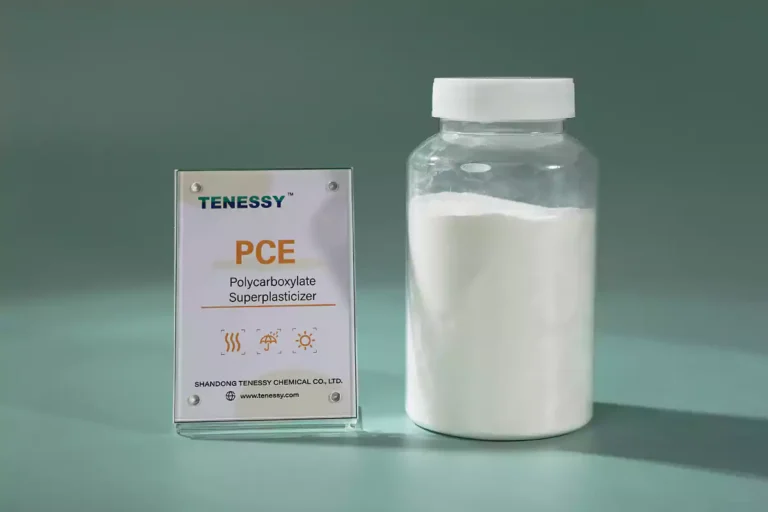
PCE, developed in Japan and Germany in the 1980s, is a comb-shaped synthetic copolymer: a carboxylated backbone with grafted polyethylene oxide side chains. We covered its chemistry in detail in our polycarboxylate superplasticizer guide, but the essential points are:
- Two-pronged mechanism: Charge-based anchoring by the backbone plus steric hindrance from the side chains.
- Extreme efficiency: 25–40% water reduction at 0.1–0.3% active solids — a tenth of the mass of PNS at the high end.
- Tunable chemistry: Side-chain length, backbone length, charge density, and molecular weight can all be adjusted, so grades can be designed for rapid strength, long retention, or very low w/c.
Mechanism: Steric hindrance dominates. The long neutral side chains create an osmotic/entropic barrier between particles that is insensitive to pore-solution ionic strength — the key to its performance at ultra-low w/c.
Performance Comparison Table
Parameter | Lignosulfonate | Naphthalene (PNS) | PCE |
Chemical class | Natural, modified biopolymer | Synthetic, sulfonated condensate | Synthetic, comb copolymer |
Water reduction | 5–10% | 15–25% | 25–40% |
Dosage (active on cement) | 0.1–0.3% | 0.6–1.2% | 0.1–0.3% |
Slump retention | 20–40 min | 30–60 min | 60–120 min |
Setting time effect | Strongly retards | Slightly retards | Minimal, design-dependent |
Early strength (same day) | Low | High | Moderate (fast grades available) |
28-day strength potential | Low–moderate | Moderate–high | High–very high |
Drying shrinkage | High | Moderate–high | Low |
Air entrainment | High (needs defoamer) | Moderate | Low, controllable |
Chloride/accelerator compatibility | Poor | Moderate | Good |
Cost per kg active | Very low | Low | High |
Typical cost per m³ concrete | Very low | Low–moderate | Moderate |
Environmental profile | Bio-based byproduct | Petrochemical sulfonation | Petrochemical; very low dosage reduces footprint |
History | 1930s | 1960s–70s | 1980s→present |
Best-fit applications | Low-grade economy concrete, some renders/self-levelers, cement grinding aids | Cost-sensitive precast and mass concrete, moderate water reduction | HPC, UHPC, SCC, pumped concrete, long-haul ready-mix |
Application Scenarios: Which Admixture Fits Where
When Lignosulfonate Is the Right Choice
- Economy-grade concrete where only modest water reduction is needed and retardation is acceptable.
- Cement grinding aids: Lignosulfonate is widely used in cement mills; the same chemistry that retards concrete is a useful grinding aid.
- Renders and masonry mortars where lignosulfonate improves workability and reduces water demand at minimal cost.
- Slump-loss-tolerant, slow-pour applications (e.g., mass concrete in cool climates, where retardation is even welcome).
- Where air entrainment is desired — lignosulfonate entrains air, which can help freeze-thaw durability when properly dosed with a defoamer to keep it in range.
Caveats: It cannot deliver high strength at low w/c; its retardation surprises contractors in warm weather; and its dark color stains light-colored architectural concrete.
When Naphthalene (PNS) Is the Right Choice
- Precast production where high early strength with low water content is needed and slump retention is not (30 minutes of life is enough before the mold closes). PNS often edges out PCE here because it does not retard and costs less per cubic meter.
- Cost-sensitive mass and structural concrete needing 15–25% water reduction at the lowest cost per m³.
- Simple, repeatable mix designs with stable cement chemistry, where PNS’s predictability is an advantage.
- Markets where PNS infrastructure and handling are established — many plants still run PNS efficiently because the dosage is forgiving.
Caveats: Rapid slump loss makes long hauling hard; water reduction tops out near 25%; compatibility with some PCE grades in the same batching is poor (they fight for adsorption sites), so never mix families in one batch.
When PCE Is the Right Choice
- HPC and UHPC: No other chemistry reaches w/c 0.20–0.30.
- Self-compacting concrete: SCC’s combination of fluidity and cohesion is a PCE specialty.
- Ready-mix with long haul times and hot weather: The 60–120 minute retention makes PCE the only practical option.
- High-rise pumping: The low viscosity and retained fluidity at low water content keep the mix pumpable.
- Architectural and exposed concrete: Low shrinkage, low air, and predictable color behavior.
- Sustainability-driven projects: Lower cement consumption per m³ of concrete reduces CO₂, which is why PCE is a pillar of low-carbon concrete strategies.
The Blended Strategy
Large producers often keep all three in inventory:
- PCE for premium products and long-haul mixes.
- PNS for economical precast and high-volume structural concrete.
- Lignosulfonate for renders, grinding aids, and the cheapest low-grade pours.
Each product finds the mix where its economics win, and the producer never overpays for performance it does not need.
Cost-Benefit and Environmental Analysis
Cost per Cubic Meter, Not per Kilogram
The classic mistake is comparing admixture prices per kilogram. The correct comparison is cost per cubic meter of concrete delivered at the required performance. A worked example for a C40 structural mix:
Admixture | Dosage (liquid, ~40% solids) | Price index per kg | Cost per m³ (index) | Notes |
Lignosulfonate | 2–4 kg/m³ | 10 | 20–40 | Retards; limited strength; needs defoamer |
PNS | 6–10 kg/m³ | 25 | 150–250 | Cheap strength gain; short retention |
PCE | 2–5 kg/m³ | 60 | 120–300 | Retention and low w/c justify premium |
Once cement savings are counted — PCE’s high water reduction typically saves 10–20 kg of cement per m³ versus PNS at equal strength — the real-world cost gap narrows dramatically, and in HPC/SCC applications PCE is simply the only option.
Environmental Profile
- Lignosulfonate is a renewable byproduct and low-impact, but its retarding and air-entraining side effects constrain its use.
- PNS is petrochemical-derived but produced by well-established sulfonation chemistry; its footprint is modest but its performance ceiling limits its contribution to low-carbon concrete.
- PCE is also petrochemical-based, but its micro-dosage (0.1–0.3% active) minimizes the environmental load per m³, and its cement-saving effect directly reduces CO₂. Modern PCE producers are also developing bio-based side-chain feedstocks (e.g., bio-PEG), which is where the next generation of low-carbon admixtures is heading.
How to Choose: A Practical Decision Framework
Step 1 — Define the Non-Negotiables
List the properties your mix must have: minimum 28-day strength, slump retention time, early demolding time, water-cement ratio ceiling, shrinkage limit. Any requirement that a family cannot meet eliminates it immediately:
- Need w/c below ~0.35? Only PCE.
- Need slump held 90+ minutes? Only PCE.
- Need demolding in 6–10 hours at low cost? PNS deserves serious consideration.
- Need only modest water reduction at minimum cost, and retardation is acceptable? Lignosulfonate wins.
Step 2 — Run the Economics on Real Prices
Get current prices for all three families, compute cost per m³ at the dosages that meet your target performance (not the datasheet “standard” dosage), and include the cement-saving effect of higher water reduction.
Step 3 — Verify Compatibility with Your Cement
Each family interacts differently with cement chemistry:
- High-C3A cements consume more dispersant and favor higher dosage of any family.
- Lignosulfonate retardation worsens with high alkali.
- Some PCE grades are sensitive to sulfate levels in cement.
- Never blend PNS and PCE in one batch without a compatibility test.
Step 4 — Validate with Your Standard Tests
Whatever family you lean toward, confirm with slump, slump retention, setting time, air content, and 28-day strength tests on your actual materials. For critical structures, add shrinkage and chloride-migration tests.
Step 5 — Partner with a Supplier Who Sells All Three
A supplier that manufactures only PCE will always sell you PCE; a supplier that offers lignosulfonate, PNS, and PCE — like TENESSY — can recommend without bias. Combine that with free samples (500–3000 g) and a 7–14 day production cycle, and you can trial all three families quickly.
FAQ